

Talking Points for Select Regulatory Updates April 2026
Revised: 260422
This is a monthly list of select regulatory and safety items of interest to General Aviation users, especially FAASTeam Volunteers in the Orlando District. Sources are in the public domain. This is not a forum to debate reg’s or policy, nor discuss specific accidents or enforcements.
Common, Open sources including, but not limited to…(See end of this report for numerous additional Internet links):
- FAA Safety Briefing magazine
- Official FAA or US Government websites
- AOPA / other reliable government / industry watchdog publications
- AvWebFlash (avweb.activehosted.com@s5.acemsrve.com; on behalf of editor@avweb.com )
- AIN Online (www.ainonline.com)
- FlightSafetyInfo.org (Flight safety information subscription newsletter): www.fsinfo.org
- FlightAware (support-newsletter@flightaware.com)
- Official current FAR’s free on-line: Visit the Dynamic Regulatory System (DRS) https://drs.faa.gov/browse for the current Title 14 Code of Federal Regulations (14 CFR) and other Agency regulatory documents. Get some practice navigating this site before you really need it; it is not intuitive.
Green hilight = Story intended for the upcoming edition; remove hilighting after editing.
Selected Regulatory and Other Updates:
1. National GA Award winners announced.
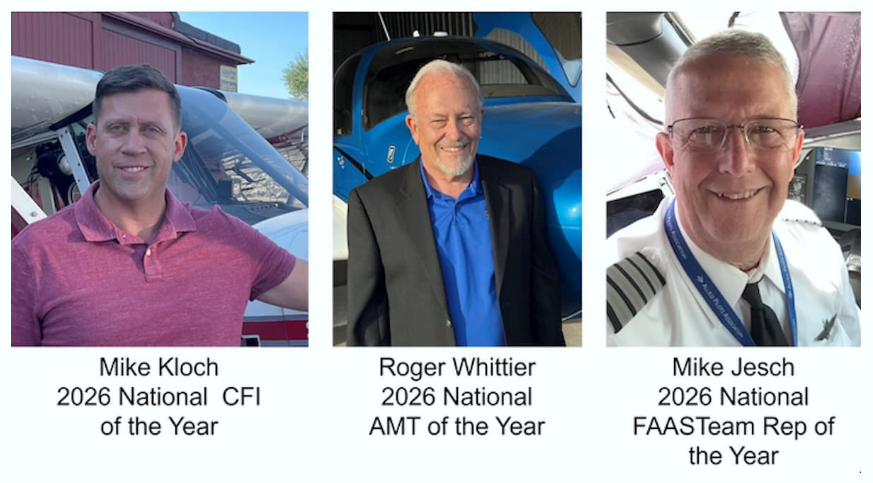
The General Aviation Awards (GAA) Board of Directors, in partnership with the FAA, have named the 2026 national honorees: Mike Kloch of Bend, Oregon, the 2026 Certificated Flight Instructor of the Year; Roger Whittier of Phoenix, Arizona, the 2026 Aviation Maintenance Technician of the Year; and Mike Jesch of Orange, California, the 2026 FAA Safety Team Representative of the Year. The three were chosen from district honorees for the award, which recognizes aviation professionals “for their exceptional contributions to flight instruction, aviation maintenance, and flight safety,” according to officials. The FAA will formally present the awards in July during EAA AirVenture Oshkosh 2026. In addition to receiving gifts from industry sponsors, each honoree’s name will be etched onto the perpetual plaque displayed in the lobby of the EAA AirVenture Museum. FMI: https://generalaviationnews.com/2026/03/21/national-general-aviation-award-winners-revealed/?2utm_source=TPOA&utm_medium=email&utm_campaign=20260324
2. FAA budget request seeks 2300 controller trainees. [7 Apr.] The FAA is asking for funding to hire 2,300 new air traffic controller trainees in its fiscal year 2027 budget request, continuing a multi-year hiring plan outlined in agency budget and workforce documents released in 2025 and 2026. The request includes $95.4 million for hiring and is part of a broader FAA funding proposal covering operations, facilities, equipment and safety oversight. FAA documents indicate that training capacity continues to shape how quickly new hires can enter the workforce. The agency said academy throughput, instructor availability, medical clearances and field training all limit the pace of hiring. To address this, the FAA has reduced its hiring process from eight steps to five, increased starting salaries for trainees and expanded recruitment through collegiate training programs. FMI: https://avweb.com/aviation-news/faa-budget-seeks-2300-controller-trainees/
3. Digital airmen certificate bill clears US House. The U.S. House of Representatives has passed H.R. 2247, the Airmen Certificate Accessibility Act, a bill from Rep; see link below. Tim Burchett, R-Tenn., that would allow pilots and other certificate holders to present either a physical certificate or a digital version when asked to show their credentials during a Federal Aviation Administration inspection. The bill applies to FAA-issued airman certificates, including medical certificates, and says a digital airman certificate could be presented from an electronic device or, where internet access is available, through a cloud-based system. It also directs the FAA to establish methods for authentication and verification and to issue a final rule implementing the change by Nov. 30, 2028. The House approved H.R. 2247 alongside several other aviation measures, including H.R. 3410 to allow civil domestic supersonic flight over land, H.R. 6267, which would direct the Government Accountability Office to examine obstacles to wider use of digital documentation for aircraft parts, and H.R. 6427, which would give general aviation airports added flexibility for some construction projects. NBAA President and CEO Ed Bolen said the package of bills addresses issues that industry groups have been raising for years. FMI: https://avweb.com/aviation-news/house-bill-digital-airman-certificates/ and https://www.congress.gov/bill/119th-congress/house-bill/2247/text
4. House passes ALERT act. On Tuesday, the U.S. House of Representatives passed the ALERT Act, aviation safety legislation designed to prevent a repeat of last year’s fatal collision between an Army helicopter and a commercial aircraft. The Airspace Location and Enhanced Risk Transparency (ALERT) Act of 2026 cleared the House by a 396–10 vote, underscoring broad bipartisan support for reforms tied to the accident that exposed gaps in coordination, airspace management, and risk awareness in congested terminal environments. Rather than focusing on a single point of failure, the ALERT Act takes a system-wide approach. Lawmakers say it incorporates recommendations from the National Transportation Safety Board (NTSB) investigation, with an emphasis on identifying and mitigating risks before they lead to incidents. [There is some speculation that the bill will fail in the Senate, which seems to prefer the ROTOR act.] FMI: https://avweb.com/aviation-news/house-passes-alert-act/
5. House moves to bring back civil overland supersonic flight.
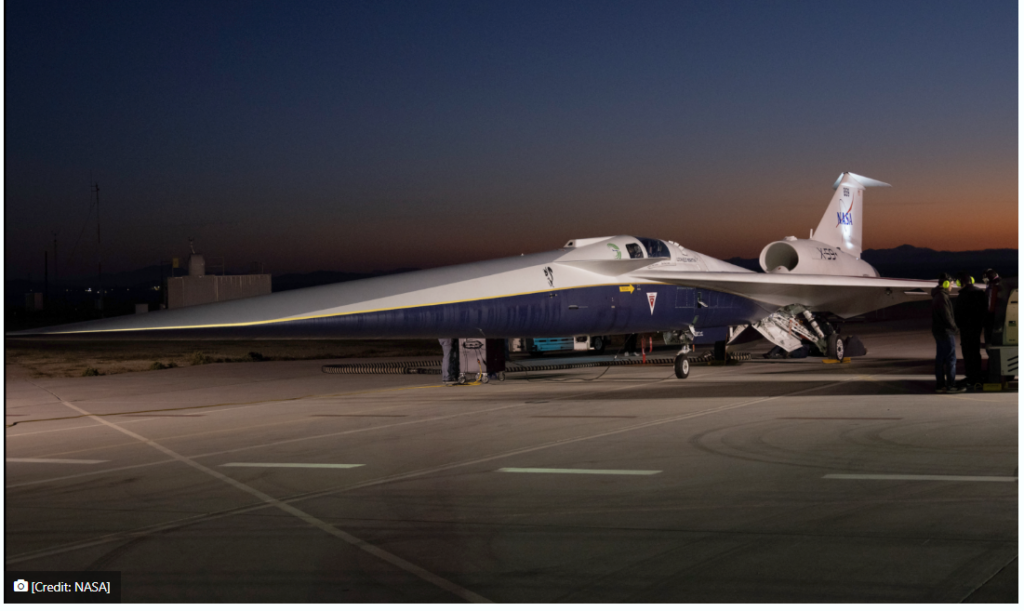
The U.S. House on Tuesday (24 Mar) passed H.R. 3410, the Supersonic Aviation Modernization Act (see link below). The bill would require the FAA to revise or issue regulations within one year to allow civil aircraft to operate in the national airspace system at speeds above Mach 1 without special authorization, provided the aircraft is flown so that no sonic boom reaches the ground in the United States. Current federal rules dating to 1973 have generally barred civil supersonic flight over the United States. The measure also would require the FAA to issue a final rule by April 1, 2027, setting noise standards for aircraft operating under the law, with those limits not exceeding the most recent takeoff and landing noise levels required for subsonic aircraft now in service. FMI: https://avweb.com/aviation-news/house-civil-overland-supersonic-flight/ and https://www.congress.gov/committee-report/119th-congress/house-report/550/1?outputFormat=pdf
6. House Transportation Chair Sam Graves to retire.
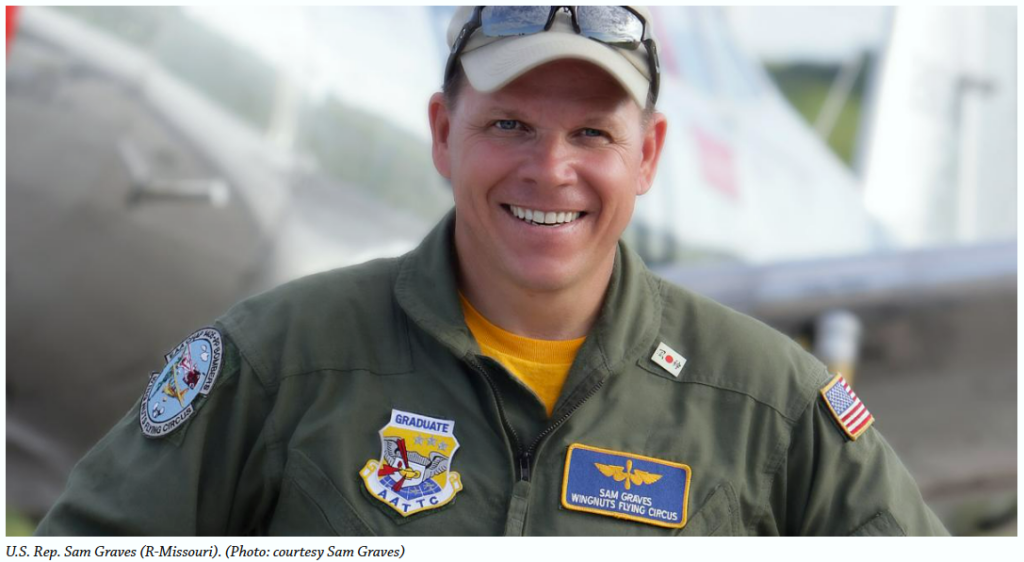
A longtime friend of GA legislation has announced his retirement. U.S. Rep. Sam Graves (R-Mo.), said Friday 27 Mar in a post on X that he will not seek reelection and that 2026 will be his final year in Congress. Graves had been a popular speaker at Sun-n-Fun for many years. The announcement sets up a leadership change at the House Transportation and Infrastructure Committee, which oversees much of the House’s aviation policy work. Graves, a pilot and 13-term representative from Missouri’s 6th District, has been involved in several major aviation measures during his time on the committee and as its chairman. These include his role in House passage of the FAA Reauthorization Act of 2024, along with his work on BasicMed, Airport Improvement Program funding, air traffic modernization and workforce-development provisions, along with support for MOSAIC. Several leadership voices among the general aviation world on Friday voiced appreciation for Graves’ work during his tenure. FMI: https://avweb.com/aviation-news/transportation-chair-sam-graves-to-retire/ and https://www.ainonline.com/aviation-news/air-transport/2026-03-27/house-ti-chairman-graves-retire-congress
7. Michael Graham is named NTSB Vice Chairman. President Trump has designated Michael Graham to serve as the vice chairman of the National Transportation Safety Board (NTSB) for a three-year term. The NTSB stated in a news release on 3 Apr. that Graham brings an extensive background in aviation and safety management to the leadership role. Prior to joining the board as its 45th member in January 2020, he served as the director of flight operations safety, security, and standardization at Wichita, Kansas-based aviation firm Textron Aviation. FMI: https://avweb.com/flight-safety/accidents-ntsb/michael-graham-named-ntsb-vice-chairman/ and
8. ATC summit features AI push, flags gaps in modernization spending. The Department of Transportation on Tuesday provided a broader update on its effort to modernize the nation’s air traffic control system during its Air Traffic Control Modernization Summit in Washington. Officials used the event to discuss progress already underway across the National Airspace System, including replacement of aging telecommunications infrastructure, installation of new radios and radar systems, and deployment of digital tools in control towers. The summit also pointed to a gap between funded infrastructure work and software systems that have yet to receive full congressional funding. FMI: https://avweb.com/aviation-news/atc-summit-ai-push-funding-gap/
9. FAA releases Part 141 modernization proposal; extends comment period through 11 May. The FAA has released a new report outlining a broad proposed rewrite of how Part 141 flight schools would operate. This proposal would shift the current system away from a model built largely around local office approvals and prescriptive requirements toward one centered on standardized oversight, data reporting and performance-based compliance. Submitted by the National Flight Training Alliance with industry representatives and subject matter experts, the March 31 document follows a year of public meetings and is intended to help guide possible future policy changes or rulemaking. Under the recommendations, one of the biggest changes would be moving much of Part 141 oversight out of individual Flight Standards District Offices and into a centralized FAA management office. That office would handle initial certification, amendments, examining authority applications and national standardization, while still delegating some inspections locally. The report says the current model can produce uneven interpretations from one district to another, slower approval timelines and added difficulty for schools trying to expand or update training programs. It also calls for replacing periodic recertification and static pass-rate benchmarks with a system based more on continuous monitoring, school performance data and documented quality controls. FMI: https://avweb.com/flight-safety/flight-training/faa-releases-part-141-modernization-plan/ and Public Engagement for the Modernization of Title 14 Code of Federal Regulations (14 CFR) Part 141 Pilot Schools | Federal Aviation Administration and https://www.federalregister.gov/documents/2026/02/02/2026-02010/notice-of-public-meeting-and-request-for-comment-on-the-modernization-of-pilot-schools . For the report, try: https://www.regulations.gov/comment/FAA-2024-2531-0293 and https://generalaviationnews.com/2026/04/02/faa-releases-report-on-pilot-training-modernization-with-only-a-10-day-comment-period/?2utm_source=TPOA&utm_medium=email&utm_campaign=20260403 and https://avweb.com/aviation-news/faa-extends-comment-period-part-141-modern/ and https://avbrief.com/faa-extends-part-141-comment-period-to-may-11/?utm_source=newsletter-182&utm_medium=email
10. NOTAM system changes take effect starting 18 Apr.

The FAA began to carry out its plans to shut down the existing NOTAM system April 18, 2026, replacing it with its new system, which was developed over the last few years. The FAA recently transitioned from its familiar U.S. NOTAM System to the newer NOTAM Management Service (link copied at the bottom of this report in the references section), according to the National Business Aviation Association. According to the FAA’s NMS website, the brand-new NOTAM Management Service migrates functionality, users, and connections from legacy systems to a single modernized NOTAM system. The new service is securely hosted in the cloud with a streamlined interface, and has a scalable and resilient architecture to accommodate current and future needs. It provides near-real-time data exchange, enabling efficient data flows and better stakeholder collaboration. The new system transforms the management of aeronautical information and supports the FAA’s mission to improve airspace safety and efficiency. Henceforth, NOTAMs accessed through the Federal NOTAM System page and third-party providers will be delivered through the NOTAM Management Service, with no operational difference expected for users. NBAA also said the FAA is recommending continued use of the older FNS NOTAM search page during the transition so operators can continue receiving current information until the transition is complete. FMI: https://avweb.com/aviation-news/faa-plans-notam-system-changeover-april-18/?utm_source=omeda&utm_medium=email&utm_campaign=Email-News0-AVW-260414-Daily&oly_enc_id=6088E0246256I1A and https://generalaviationnews.com/2026/04/12/changeover-to-new-notam-system-planned-for-april-18/?2utm_source=TPOA&utm_medium=email&utm_campaign=20260414
11. Audit reveals ATC cybersecurity vulnerabilities. A U.S. Department of Transportation Office of Inspector General (DOT IG) report released earlier this month says the FAA has not fully put in place required cybersecurity protections for 45 of its most critical computer systems supporting the National Airspace System. In particular, this refers to systems whose failure or compromise could have severe or catastrophic effects on operations, including air traffic control and related services. According to the report, 15 of the 45 systems were still being managed under older National Institute of Standards and Technology security standards instead of the current version, and FAA records showed 1,836 of 16,245 required protections had not yet been fully implemented. The FAA agreed with all four recommendations in the report and proposed corrective actions, according to the Office of Inspector General. The audit follows a 2021 Office of Inspector General review that found the FAA had recategorized these systems as high-impact but had not fully implemented the added protections that classification required. A separate 2024 Government Accountability Office review found that 105 of the FAA’s 138 air traffic control systems were considered unsustainable. FMI: https://avweb.com/aviation-news/faa-audit-cybersecurity-gaps-in-atc-system/
12. FAA accepts first Light Sport maintenance course for powered parachutes.
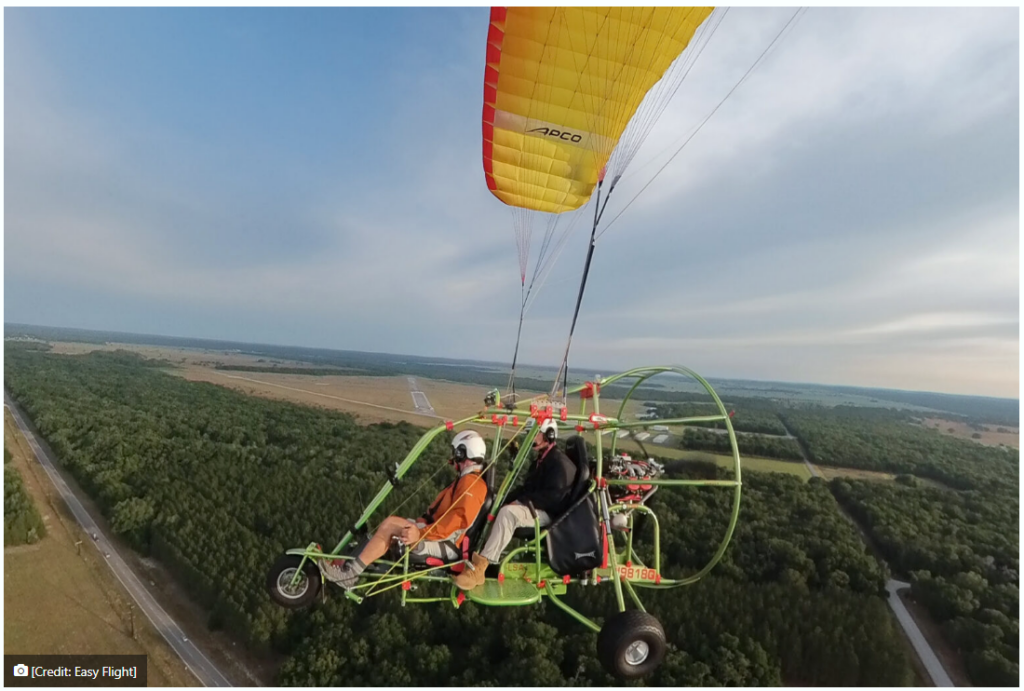
The FAA has accepted a new light-sport repairman maintenance course for powered parachutes. The course was developed by Roy Beisswenger, a longtime instructor and designated pilot examiner, and is offered through Easy Flight, an Illinois-based training provider. Easy Flight announced the news at SUN ‘n FUN on Friday and said it is the first powered parachute-specific course of its kind, as well as the first accepted since the introduction of MOSAIC. The course is intended for pilots, mechanics and prospective owners who want more formal training in maintenance, inspections and troubleshooting. The company said the program includes instruction on powered parachute systems, hands-on maintenance work and condition inspections. It is also aimed at owners of Special Light Sport Aircraft who want to perform maintenance and annual inspections. Easy Flight said the course is offered in a limited-enrollment format with an emphasis on hands-on instruction and direct interaction with the instructor. FMI: https://avweb.com/air-shows-events/sun-n-fun/light-sport-maintenance-powered-parachute/
13. Airport landing fees update: ADS-B bill on DeSantis’ desk for signing. Sincere thanks to AOPA’s Stacey Heaton for collaboration on this one. Senate Bill 422 prohibits airports from using information derived from automatic dependent surveillance broadcast (ADS-B) systems emitted from certain aircraft as a means of collecting fees from owners. This rule is limited to aircraft with a gross weight of 12,499 pounds or less operating under FAA rules and applies under the following two scenarios:
- The operation for which a fee would be assessed is a departure or a landing, including touch-and-go landings
- The fee would be assessed based on an aircraft entering into the airspace of the airport where the fee is assessed
If signed, the bill will take effect on July 1. FMI: https://www.clickorlando.com/news/florida/2026/04/22/desantis-gets-20-new-florida-bills-on-his-desk-heres-what-happens-if-he-oks-them/
14. House committee advances ALERT act (HR 7613). The House Transportation and Infrastructure Committee has advanced the Airspace Location and Enhanced Risk Transparency Act of 2026, known as the ALERT Act, a bill that would direct the FAA to move on a series of aviation safety measures tied to collision-mitigation technology, air traffic procedures and military aircraft operations. The committee approved the measure by a 62-0 vote on Thursday 26 Mar. The bill would require the FAA to set a deadline no later than Dec. 31, 2031, for certain aircraft to be equipped with collision-mitigation technology, while also allowing an alternative means of compliance using portable ADS-B In receivers or other equipment that displays on a portable device, electronic flight bag or panel-mounted display. The legislation also calls for a memorandum of agreement between the Department of Transportation and Department of Defense covering the operation of collision-mitigation technologies and ADS-B Out, or similar systems, on Defense Department aircraft. The bill still does not require installation of ADS-B In, and that is a point of friction with the Airline Pilots Assn, a union representing thousands of airline pilots. The NTSB expressed its view on Thursday after reviewing the most recent version of the bill on Wednesday that the current wording of the ALERT Act properly addresses its recommendations following last year’s DCA collision. This comes as a shift for the board, whose chair, Jennifer Homendy, previously expressed concerns with a prior version of the ALERT Act; that story was reported in the March newsletter. FMI: https://avweb.com/aviation-news/house-committee-advances-alert-act/ and https://www.aopa.org/news-and-media/all-news/2026/march/26/house-committee-passes-amended-alert-act-includes-papa?utm_source=ebrief&utm_medium=email
15. New FAA website clarifies MOSAIC policy on Repairman certificates. The FAA recently launched a new website dedicated to clarifying the privileges, limitations, and process to obtain repairman certificates of varying types. FAA Repairman Certificates provide a way to work hands-on in aviation maintenance without earning an A&P certificate. According to officials with the Experimental Aircraft Association, the section on light-sport repairmen is of particular interest to the general aviation community, as the privileges of these certificates were expanded by MOSAIC (Modernization of Special Airworthiness Certification). Under the new rules, holders of the Repairman Light Sport certificates can now also conduct condition inspections on experimental amateur-built (E-AB) aircraft in addition to light-sport aircraft. Light-sport repairmen with an inspection rating (LSRI) may inspect aircraft that they own, while those with a maintenance rating (LSRM) may inspect any E-AB and for hire. The new website explains the process for obtaining these certificates and lists the current course providers. FMI: https://generalaviationnews.com/2026/03/22/new-faa-website-clarifies-mosaic-policy-on-repairman-certificates/?2utm_source=TPOA&utm_medium=email&utm_campaign=20260324 and https://www.faa.gov/repairmen
16. FAA releases clarification for CFI’s under MOSAIC. The FAA has just published InFO 26006, Privileges and Qualifying Endorsements for Title 14 of the Code of Federal Regulations (14 CFR) Part 61 Flight Instructors with a Sport Pilot Rating (part 61 subpart K) and Sport Pilot Certificate (part 61 subpart J). This InFO provides clarification for pilots with a higher grade of pilot certificate exercising sport pilot privileges, flight instructors with a sport pilot rating (subpart K), and flight instructors with category and class ratings issued under subpart H who provide training and qualifying endorsement privileges. FMI: https://www.faa.gov/other_visit/aviation_industry/airline_operators/airline_safety/info/all_infos/InFO26006.pdf . To find any published InFO, check out https://www.faa.gov/other_visit/aviation_industry/airline_operators/airline_safety/info/all_infos . This link is now permanently listed in the references below.
17. Children of the Magenta Line: What the data shows. The general aviation fatal accident rate hit a historic low of 0.65 per 100,000 flight hours in 2023. GPS, glass cockpits, autopilots, and electronic flight bags have given pilots more information and capability than at any point in aviation history. By every measure, technology is saving lives. But an independent analysis of 150,000 federal safety records by AviatorDB reveals that the same technology is creating a dangerous dependency — pilots who can fly with automation but not without it. The investigation cross-referenced NTSB accident records, NASA’s confidential Aviation Safety Reporting System (ASRS), and FAA data to identify a pattern the aviation industry has debated since 1997, when American Airlines Captain Warren Vanderburgh warned that automation dependency would erode the fundamental flying skills that keep aircraft in the air. He was right — three major airline crashes attributed to automation confusion killed a combined 388 people, AviatorDB officials noted. He called the phenomenon “Children of the Magenta Line” — a reference to the magenta course line on cockpit displays that automates navigation from takeoff to landing. Vanderburgh was talking about airline pilots, but 29 years later, the same pattern has migrated to general aviation, where pilots have fewer hours, less training, and fly behind glass cockpits more capable than what Vanderburgh operated in the cockpit of a 757. FMI: https://generalaviationnews.com/2026/03/22/children-of-the-magenta-line-what-150000-safety-records-reveal-about-pilots/?2utm_source=TPOA&utm_medium=email&utm_campaign=20260324
18. Flight testing begins on new light twin from Poland; Intended as Light Sport Aircraft.

Flight testing has begun on the newest airplane from prominent Polish aeronautical engineer Tomasz Antoniewski. The AT-6 Twin PSE began its first round of flight tests at Mielec Airport in Poland in early March 2026, according to Antoniewski, who has a legacy in aviation dating back to the 1990s. According to Antoniewski, his strategy is to provide a Zero to ATP family of aircraft, which would allow students to stay within the same design family. His new designs are targeting the new MOSAIC (Modernization of Special Airworthiness Certification) regulations. Because MOSAIC removed previous restrictions like weight limits and fixed landing gear, Antoniewski’s more complex designs could be sold as LSAs in the United States. If all goes to plan, flight testing will wrap up in November 2026 and the aircraft could debut in the U.S. in 2027. FMI: https://generalaviationnews.com/2026/03/24/flight-tests-begin-on-new-twin-trainer/?2utm_source=TPOA&utm_medium=email&utm_campaign=20260325
19. X-59 supersonic research aircraft lands early on second flight.

NASA’s new supersonic X-59 jet took to the skies for the second time ever on Friday (March 20), but it didn’t stay up for long. The potentially revolutionary X-59 landed just nine minutes after takeoff on Friday, its sophomore effort cut short by a[n unspecified] warning light in the cockpit. “Despite the early landing, this is a good day for the team. We collected more data, and the pilot landed safely,” Cathy Bahm, project manager for NASA’s Low-Boom Flight Demonstrator at NASA’s Armstrong Flight Research Center in Edwards, California, said in a statement on Friday. “We’re looking forward to getting back to flight as soon as possible.” FMI: https://www.space.com/technology/aerospace/2nd-ever-test-flight-of-nasas-quiet-x-59-supersonic-jet-cut-short-by-glitch?utm_term=6A2C0E1C-E567-40B3-A8FF-AB7CCF4191E7&lrh=c778d6679eb957988d550a72caa7b4ccd54d050c672f1dffe7a684ef936e6244&utm_campaign=58E4DE65-C57F-4CD3-9A5A-609994E2C5A9&utm_medium=email&utm_content=3C5479FF-4E6A-406A-86A4-156244AD6B99&utm_source=SmartBrief
20. FAA clears key step for ZeroAvia electric engine.

The FAA earlier this month published final special conditions for ZeroAvia’s ZA601 electric engine, establishing additional safety standards for the company’s 600-kW propulsion system as it moves through the type-certification process. The rule is part of the certification path for the electric propulsion system that the company plans to use in its ZA600 hydrogen-electric powertrain for 10- to 20-seat commercial aircraft. The FAA said the engine’s electric motor, controller and high-voltage electrical system represent a “novel or unusual design feature” not fully addressed by existing airworthiness standards for aircraft engines. The FAA said the special conditions are needed because current Part 33 engine standards were developed around turbine and reciprocating engines rather than electric propulsion systems. The final rule applies to ZeroAvia’s Model ZA601 electric engine and took effect March 18. FMI: https://avweb.com/aviation-news/faa-clears-step-zeroavia-electric-engine/
21. UAS update 1: FAA wants feedback on UAS airport and droneport integration. On 23 Mar, Avweb reported that a comment period has opened for the public to make inputs on how drone operations fit into airport and droneport planning, design and infrastructure. The FAA is asking airports, operators and other stakeholders to weigh in on how unmanned aircraft systems (UAS) are being incorporated into airports and droneports, with public comments due April 22. The notice covers a proposed information collection tied to UAS planning, design and infrastructure needs as drone and other AAM activity expands. The agency is looking for feedback on what airports and droneports may need to support those operations and how that work could affect future development. According to the notice, the information would help the FAA assess evolving issues around planning airports and related facilities as unmanned aircraft become a larger part of the operating environment. FMI: https://avweb.com/recent-updates/evtols-urban-mobility/faa-uas-airport-droneport-integration/
22. UAS update 2: NASA studies plan to deploy multiple drones above Mars.

A new Mars exploration idea seemingly would drop a hornet’s nest of helicopters from high above the Red Planet. The idea comes from the world of unmanned aerial vehicle (UAV) concepts here on Earth, but is designed for exploring another world: Mars. AeroVironment of Arlington, Virginia and NASA’s Jet Propulsion Laboratory today debuted “Skyfall,” a concept for deploying next-generation Mars helicopters that could help pave the way for human landing on Mars through autonomous aerial exploration. The online story is accompanied by a cool video! FMI: https://www.space.com/astronomy/mars/wild-new-skyfall-mars-mission-would-drop-6-scout-helicopters-onto-the-red-planet-from-the-air
23. UAS update 3: FAA, Pentagon clear use of anti-drone laser system at border. Avweb reported on 13 Apr that the Department of War and the FAA have allowed the use of a system designed to bring down unauthorized drones. The FAA and Pentagon have signed an agreement clearing the way for the use of a high-energy laser counter-drone system along the southern U.S. border after two February incidents in Texas temporarily disrupted airspace near El Paso and Fort Hancock. Officials said the FAA had completed a safety assessment and determined that, with proper controls in place, the system does not pose undue risk to passenger aircraft. “Following a thorough, data-informed Safety Risk Assessment, we determined that these systems do not present an increased risk to the flying public,” FAA Administrator Bryan Bedford said. FMI: https://avweb.com/aviation-news/drones/faa-pentagon-clear-border-anti-drone-laser/
24. Upcoming TSA monthly FTSP (Flight Training Security Program) webinars for CFIs. The Transportation Security Administration has initiated a series of monthly webinars for the Flight Instructor community, to provide an overview of any policy updates or FTSP Portal changes and to answer audience questions. It is not required to attend these webinars; think of them as a customer service function from the FTSP staff at TSA. These webinars are free, but pre-registration is required. The webinar schedule is as follows:
Tuesday, May 12 at 1300 EDT → Click Here
Tuesday, June 9 at 1300 EDT → Click Here
Remember, IAW 49 CFR 1552.3, all current CFI’s are required to register with the TSA and create an account with that agency.
25. GAJSC Safety Promotion Outreach Topics of the Month (NPP63; formerly NPP14) for FY-2026.
The new list of Topics of the Month (TOM’s; NPP63) and Airworthiness Topics of the Quarter (TOQ’s; NPP60) from the General Aviation Joint Safety Committee (GAJSC) for FY-2026 have been released. Reps can download this media off the FAASTeam National Collaborative Center (NFRCC) Sharepoint site at FAASafety.gov. Volunteers who mail me a USB flash drive with at least 1 GB of capacity can obtain the full catalog of media, including NPP60 and NPP63, for the current year. Previous years are available, depending on memory capacity. Here are the topics of the month (TOM’s) for FY-26; I can provide a slightly more detailed description with your download (and available on request!). The GAJSC has a free subscription service to its e-newsletter; check out The TOM / TOQ media for FY-2026 are posted in the FAASTeam Sharepoint site; editor will make these available to other Reps with prior coordination.
Oct 2025: Human Performance.
Nov 2025: CFIT.
Dec 2025: Winter Ops.
Jan 2026: Risk Management.
Feb 2026: Multi-Engine Transition.
Mar 2026: Human Factors and WINGS.
Apr: 2026: Angle of Attack Awareness.
May 2026: Owner-Operator and Mechanic Relations.
Jun 2026: Hindsight Bias.
Jul 2026: Tailwheel Endorsement.
Aug 2026: Pre-and In-Flight Wx Resources
Sep 2026: Advanced Air Mobility.
26. GAJSC GA Maint. Safety Outreach Topics of the Quarter (NPP60; formerly NPP41) for FY-2026. Along with the Topics of the Month shown above, national FAASTeam also publishes a series of Airworthiness Topics of the Quarter. For FY-26, the selected topics are as follows:
- First Quarter (Oct – Dec): Wiring.
- Second Quarter (Jan – Mar): Airworthiness.
- Third Quarter (Apr – Jun): Field Approvals.
- Fourth Quarter (Jul – Sep): Helicopter Mx Accidents.
The same structure surrounds these topics as for Topics of the Month. In other words, resources are available; just add speaker and venue! Note: all FY-23 thru FY-25 topics available. Contact the Orlando FSDO FPMs for more info!
27. Airmen Certification Standards (ACS) and Practical Test Standards (PTS) updates. Make sure you go to your next Practical Test armed with the latest ACS or PTS as appropriate!!! The FAA is gradually replacing all PTS with the new and improved ACS; only a few PTS have not yet been converted. All current ACS’s can be found at this website: http://www.faa.gov/training_testing/testing/acs/. An ACS Companion Guide for Pilots is available to help explain ACS and integrate ACS into one’s training plans: https://www.faa.gov/training_testing/testing/acs/acs_companion_guide_pilots.pdf .
No new ACSs or PTSs to report this month.Airmen Testing Community Advisory website: https://www.faa.gov/training_testing/testing. The national ACS Focus Team encourages and invites all users of the ACS to please let them know if you see any possible problems or issues with the ACS, or questions not covered already in the Airman Certification Standards FAQ link on the webpage above. You do not have to go through anyone or any organization to reach the ACS Focus Team – just send an email to: 9-AVS-ACS-Focus-Team@FAA.gov The ACS Focus Team welcomes your feedback.
PTS. PTS’s are still very much around! The link to Practical Test Standards (PTS) is at the end of this report in the FAA resources section. Although many PTS are still in use, they are not being substantially updated, and ACS will eventually replace all PTS pubs.
28. FAA Safety Briefing magazine. The March/April 2026 issue of FAA Safety Briefing magazine focuses on the realm of rotorcraft operations. Articles in this issue focus on the real-world risks helicopters face, along with insights on the FAA’s strategy to improve safety in this dynamic operating environment. Look for it at a FAASTeam event near you soon. FMI: You can view the magazines past and present on-line at https://www.faa.gov/newsroom/faa-safety-briefing-magazine or via www.faasafety.gov.

Attention FAASTeam Lead Reps: If you have not been receiving these magazines lately, but expected to, contact your FPM. Also, please let the FPMs know if your needs change.
29. And now, Regulatory trivia.

Question: “Vh” (defined in FAR 1.2 as maximum speed in level flight with maximum continuous power) is not a new term, but now forms the basis for several Sport Pilot endorsements under the new MOSAIC regulations. Vh is not published in the POH / AFM for most aircraft, and can vary with atmospheric parameters like density altitude, so how do I know what the officially accepted “Vh” is for my (or any) aircraft?
Answer: To be determined! There is a lot of confusion surrounding this policy. The confusion is rooted in 14 CFR 61.327, which requires training and endorsements for airplanes with a Vh less than or equal to 87 KCAS, and for any aircraft (not just airplanes) with a Vh greater than 87 KCAS. A grandfather date of April 2, 2010 applies to the regulation addressing airplanes with Vh < 87. The new Advisory Circular AC 61-146, paragraph 3.4, repeats the regulatory requirement, but does not point stakeholders in any direction to find Vh for any specific model. One thing is normally true: Vh > Vno, so if the Vno (Maximum structural cruising speed, the lower limit of the yellow arc on the Airspeed Indicator) is above 87 KCAS, the Vh endorsement may apply, specifically Endorsement A.25, as published in Advisory Circular AC 61-65K, Appendix A.
In my opinion, this is a significant area for improvement within the new regulations for Sport Pilots / Light Sport Aircraft, and would be appropriate to clarify when “MOSAIC Phase 2” is released in late July. The Vh regulatory language may have been inserted to keep “Fat Ultralights” out of the Light Sport Aircraft community. In researching Vh, the best source would be the aircraft manufacturer. Data like Vh should be a part of the aircraft’s type certificate, which is normally held by the manufacturer. If the manufacturer is no longer in existence, an inquiry with a trusted source such as EAA or AOPA may prove useful. It is my wish that a table of accepted Vh values might be published online in the near future, although it is highly unlikely the FAA will initiate such a resource.FMI: Check out 14 CFR 61.327 and AC 61-146, both of which can be found in drs.faa.gov, the Dynamic Regulatory System.
30. Runway Safety Action Team (RSAT) Calendar (NPP05). FY-26 RSAT calendar is developing, and will fill up quickly in the next several months. Here’s our latest info on upcoming RSAT’s within the Orlando District.
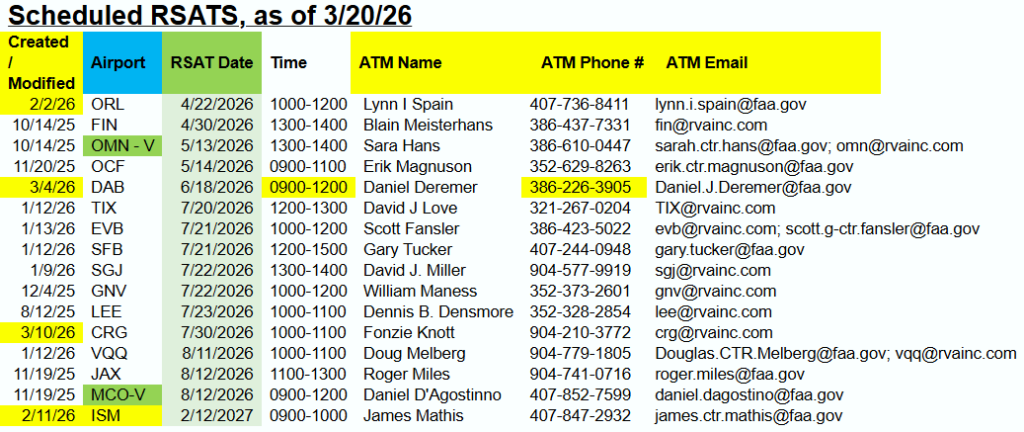
The public is invited to attend any of these meetings. FAASTeam Lead Reps: Please coordinate with ATC and help get the word out via SPANS message, and incentivize attendance with WINGS Knowledge credit. RSAT meetings combined with a Pilot – Controller Forum are an excellent draw. Airports highlighted in green and bearing a -V suffix are virtual events (Zoom or equivalent), not in-person meetings unless stated.Please note the airports within your area. Please work well ahead of the schedule: Submit the associated SPANS message 3 weeks prior to any RSAT meeting in your area of responsibility. Set up any virtual event as a webinar in SPANS and obtain the meeting link from ATC. Contact the ATM for the respective airport or contact the FPM at the Orlando FSDO for more info relating to the RSAT’s at the airports in your area. RSAT info can and does change!!! Data courtesy of FPM Javier Calderin, Orlando FSDO.
31. Florida Airshows and Aviation Events calendar. Here is the latest compilation of known shows and events coming up within Florida (besides events you can find in faasafety.gov). Cancellations will be shown in strike-through font. As always, be vigilant for associated TFR’s with any airshow, rocket launch, racing event, wildfires or VIP visits (see Review of Current TFR’s below). Please check the official show websites for more info. Boldface means the event is within the Orlando FSDO. ICAS source: https://www.airshows.aero/Page/ASCalendar ;
Also, AIN Online is a worldwide source. Another overall source for Florida: https://floridareview.co.uk/florida-events/florida-air-shows
2026:
Forum 82 – The Future of Vertical Flight (KPBI) – 5 May
Air Dot Show Fort Lauderdale (Ft. Lauderdale), 9 – 10 May
Vero Beach Air Show (KVRB), 16 – 17 May
Hyundai Air and Sea Show (Miami Beach), 24 – 25 May
Melbourne Air Show (KMLB), 6 – 7 Jun
Tallahassee Balloon Festival (North Florida Fair), 13 Jun
Plane Time 33 (Florida Aviation Network live-stream): 20 Jun
Pensacola Beach Air Show (P’cola Beach), 18 – 19 Jul
Plane Time 34 (Florida Aviation Network live-stream): 15 Aug
Plane Time 35 (Florida Aviation Network live-stream): 17 Oct
Air Dot Show Orlando (KSFB), 17 – 18 Oct
NAS Jacksonville Air Show (KNIP), 17 – 18 Oct
Blue Angels Homecoming Air Show (KNPA), 6 – 7 Nov
Florida Int’l Air Show (KPGD), 7 – 8 Nov
Vintage Weekend Ocean Reef Air Show (Key Largo), 4 – 5 Dec
Plane Time 36 (Florida Aviation Network live-stream): 19 Dec
32. Current GA aeronautical charts & pubs for central Florida. Make sure your chart database is current. Here are the current and future Dates of Latest Editions (DOLE’s) for the 56-day aeronautical pubs. Most pubs are on a 56-day cycle, and digital pubs follow suit:
2026: 19 Mar, 14 May, 9 Jul, 3 Sep, 29 Oct, 24 Dec.
These dates cover the following pubs and their digital equivalents on your EFB:
IFR Low Alt En-route Charts (e.g., L-23);
IAP’s – US Terminal Procedures Publication (e.g., SE-3);
Chart Supplement (formerly the A/FD) [Man, I sure miss those back-cover indices!]
Jacksonville and Miami VFR Sectionals;
Tampa / Orlando and Miami Terminal Area Charts.
FMI: Check out the following website for current chart editions: https://www.faa.gov/air_traffic/flight_info/aeronav/productcatalog/doles/
Also: Check out the following official website as a navigation training resource: https://www.faa.gov/air_traffic/flight_info/aeronav/digital_products/aero_guide/
for a link to all chart symbology used for all FAA aeronautical charts and pubs.
33. Review of current Florida TFR’s. The ones shown in the screen shots below were valid just within Florida at the time of final editing, but can and do change or expire, and this newsletter is not to be construed as an official source. Also check “USA” NOTAM FDC 0/0367 to be sure of details; see note “a” below. Note the long-term TFRs over Mar-A-Lago and another one, FDC 5/2858 over Alligator Alcatraz. Always check NOTAM’s each time before you fly! FAA’s official TFR NOTAM website is http://tfr.faa.gov/tfr2/list.jsp. Also, check out their interactive TFR map page at https://tfr.faa.gov/tfr3/?page=map. Other resources are available as well, including via www.1800wxbrief.com, www.AOPA.org/go-fly/tfrs and on many flight planning apps. In flight, contact with ATC including VFR flight following, or contacting Flight Service could be helpful. For planning info regarding other Special Use Airspace, visit www.SUA.FAA.gov.
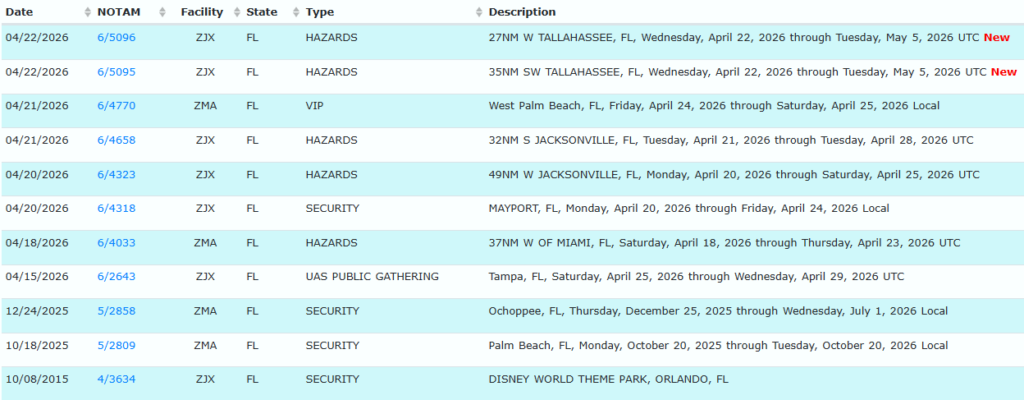
- Nationwide: “USA” NOTAM FDC 0/0367 covers flights near “qualified stadiums” (defined in the NOTAM) during certain sporting events. Going to the Bahamas or across the ADIZ? Check this one out: “USA” NOTAM FDC 2/8783, covers operations across the ADIZ.
- UAS Operators: Check out the following:
- FDC 3/9568, covering UAS ops near naval submarine bases (Kitsap, WA and Kings Bay, GA). This NOTAM replaces FDC 1/8373.
- FDC 3/0104, covering UAS ops near DOE energy facilities and DOD mobile assets, including convoys and ships. This NOTAM replaces FDC 1/8374.
- FDC 3/2496, addressing UAS restrictions near “National Defense Airspace”. This NOTAM replaces FDC 1/0488.
- FDC 3/6405, addressing UAS ops over the territorial and navigable waters of the US.
- FDC 3/4452, addressing UAS ops in the vicinity of Cape Canaveral and Kennedy Space Center.
- Don’t forget to always check other FDC NOTAM’s for “USA” on the above web page, in addition to FL or wherever else you may be going. Set the “Center” filter to “USA”, then hit “Go” next to that box, and you’ll see the desired search results. Most of these NOTAM’s are effective nation-wide.
- Finally, if filing IFR, remember to check FDC NOTAM’s for the instrument approaches at your destination. Like TFR’s, these NOTAM’s are regulatory, too, so you have to adhere to their applicable portions. The easiest way to obtain this info is via commercial flight planning software / approved sites when filing and obtaining a standard wx brief.
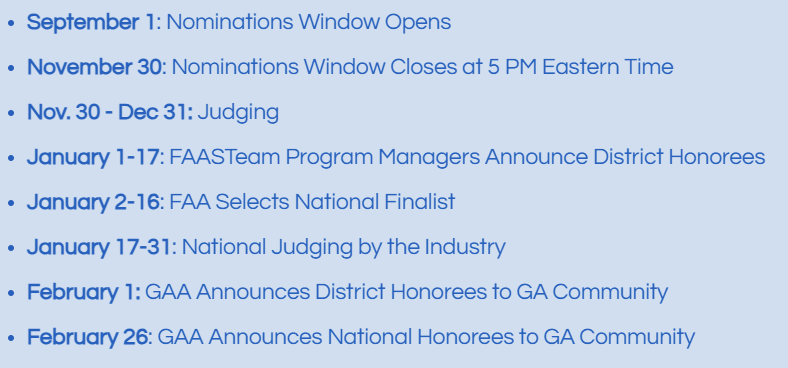
34. GA awards update (NPP02). See also the lead story above. The Orlando district has produced many national honorees, including Obie Young, Walt Schamel, Vicki Sherman, the late Rock Rockcastle, and three national winners between 2017 and 2023: Mark Ducorsky (2017 Rep of the Year), the late Ron Timmermans (2021 CFI of the Year, NAFI Flight Instructors’ Hall of Fame 2022) and Bob Raskey (2023 CFI of the Year). FMI: www.generalaviationawards.com The most recent GA Award calendar from the website is shown below, and it generally remains perennially stable (government shutdowns notwithstanding!):
35. Contacting Bob Jex. Bob Jex, editor of this newsletter, can be e-mailed at bob.jex@yahoo.com. Please update your contact info and use this address as the primary. The earthlink.net email is secondary; for the time being, both addresses work.
As always, fly safe!
Archived Links to select official pubs and sites of interest:
Each story above contains a reference link when available. Looking for a particular web resource not listed? Ask me and I’ll look for it. Once I find it, I’ll list it here! E-mail requests to bob.jex@yahoo.com. New listings in yellow for first month or so.
Federal Aviation Administration (FAA); see elsewhere within this newsletter
- Orlando FSDO website: https://www.faa.gov/about/office_org/field_offices/fsdo/orl
- FAASTeam Website (center of FAASTeam universe): www.faasafety.gov
- Dynamic Regulatory System (DRS): drs.faa.gov/browse (Relocated link)
- Airmen Inquiry portal: https://amsrvs.registry.faa.gov/airmeninquiry/
- FAA introduction for international audiences: https://avssp.faa.gov/avs/afsfaast/asw/Hughes%20Inbox/Videos/We%20Are%20Aviation%20Safety.mp4
- News, press releases, fact sheets, FAA Safety Briefing, social media: https://www.faa.gov/news/
- Another source of FAA information including videos: www.medium.com/faa
- FAA publication sign-up, for free subscriptions on a wide variety of information: https://public.govdelivery.com/accounts/USAFAA/subscriber/new?preferences=true#tab1
- FAA Newsroom: A very broad source of FAA news, fact sheets, speeches, testimony, social media: https://www.faa.gov/newsroom
- Airport funding (Bipartisan Infrastructure Law): https://www.faa.gov/bil/airport-infrastructure ; search by relevant filters, including state or even airport ID.
- FAA information on relevant COVID-19 issues: https://www.faa.gov/coronavirus/
- Unleaded AvGas link: https://www.faa.gov/about/initiatives/avgas
- Media / NGO coverage on unleaded AvGas over the years: https://www.faa.gov/about/initiatives/avgas/media
https://www.aopa.org/advocacy/100-unleaded-avgas?_gl=1*1oqz114*_gcl_au*NTU2ODA4MjU0LjE3MzgwNjg1OTQ.&_ga=2.47614759.1268920621.1740398802-1115559188.1738068595 - FAA 5G on-line resource: https://www.faa.gov/5g
- Pilot Training resource link: https://www.faa.gov/pilots/training/
- Airman Testing: https://www.faa.gov/training_testing/testing/
- FAA’s new NOTAM Management Service (NMS): https://nms.aim.faa.gov/
- Listing of all InFOs: https://www.faa.gov/other_visit/aviation_industry/airline_operators/airline_safety/info/all_infos
- Chart Supplement (formerly called the Airport / Facility Directory or AFD): https://www.faa.gov/air_traffic/flight_info/aeronav/digital_products/dafd/
- Special Use Airspace short-term schedule: https://sua.faa.gov/sua/siteFrame.app
Zoom in on areas of interest; click for pop-up schedule - Aviation Training Handbooks (Free to download!): https://www.faa.gov/regulations_policies/handbooks_manuals/aviation/
- FAA website for Draft Orders, Notices, and Handbooks Open for Comment: https://www.faa.gov/aircraft/draft_docs/afs_orders/
- FAA website for NPRM’s, Final Rules: https://www.faa.gov/regulations_policies/rulemaking/recently_published/
- CFI “no-expiration”-certificate NPRM updates: https://bit.ly/3wla3sP
- Legal Interpretations search site (to help clarify regulatory issues): https://www.faa.gov/about/office_org/headquarters_offices/agc/practice_areas/regulations/Interpretations/
- FAA Safety Briefing magazine: www.faa.gov/news/safety_briefing
- Fly Safe fact sheets (Genesis for many GAJSC TOM’s): https://www.faa.gov/newsroom/safety-briefing/faa-safety-briefing-fact-sheets
- PTS link: www.faa.gov/training_testing/testing/test_standards/
- ACS link: http://www.faa.gov/training_testing/testing/acs/
- UAS (drones) link: www.faa.gov/uas
- UAS Registration: https://faadronezone.faa.gov
- Drone Dispatch (UAS News): Drone Dispatch (faa.gov)
- ADS-B Service Availability Prediction Tool (SAPT): https://sapt.faa.gov/default.php
- Also contains ADAPT, RAIM Prediction, and RAIM Summary info.
- Runway Incursion prevention series: www.faa.gov/go/FromTheFlightDeck.
- Runway Safety Pilot Simulator: www.runwaysafetysimulator.com
- Weather cameras (WCAM) program: www.weathercams.faa.gov
- Birdstrike website: https://wildlife.faa.gov/home
- Noise complaints: https://noise.faa.gov/noise/pages/noise.html Just remember, the FAA does not regulate noise in most GA aircraft!
- FAA forms index: https://www.faa.gov/forms/index.cfm/go/document.list/
- Laser strike public reporting: https://www.faa.gov/aircraft/safety/report/laserinfo
- Accident Lessons Learned database: https://lessonslearned.faa.gov
- Flight Standards Position Reports (NOTAL): FS Position Reports (faa.gov)
- Safety Alerts and Charting Notices page: Safety Alerts and Charting Notices (faa.gov)
- Space flight operations: FAA’s Operational Information System (OIS): https://www.fly.faa.gov/ois/?legacy=true. Go to “Ops Plans” on the menu and select “Current Operations”.
- ICAO Flight Plan Brochure: https://www.faa.gov/about/office_org/headquarters_offices/ato/service_units/air_traffic_services/flight_plan_filing/media/fpl_brochure_(change3).pdf
- (For the AOPA equivalent product, go to http://download.aopa.org/advocacy/0403_icao_tip_card.pdf)
- Instrument Flight Procedures (IFP) support (IAP’s, etc.): https://www.faa.gov/air_traffic/flight_info/aeronav/procedures/application/
- UAS Remote ID briefing: https://www.faa.gov/uas/getting_started/remote_id
- UAS Data Delivery Site, or UDDS: https://udds-faa.opendata.arcgis.com/
- UAS Airspace card:
- Jobs link: https://www.faa.gov/jobs/ and www.usajobs.gov
- AME Guide (Medication deferral guidance for AME’s): https://www.faa.gov/about/office_org/headquarters_offices/avs/offices/aam/ame/guide/pharm/dni_dnf/ or https://www.faa.gov/ame_guide/media/ame_guide.pdf
- Chart Supplement; Comments or Corrections: E-mail: https://www.faa.gov/air_traffic/flight_info/aeronav/aero_data/
Snail-Mail:
FAA, Aeronautical Information Services
1305 East West Highway
SSMC-4, Suite 4400
Silver Spring, MD 20910-3281 Ph: (800) 638-8972
They have an approx. 2-mo-prior publication cut-off date.
Federal Register (Exit pipe for allfederal regulations)
https://www.federalregister.gov/
Another broad-based, multi-agency regulatory updates website: www.regulations.gov
MOSAIC Rule (not all-encompassing; many sources are available):
- FAA site: https://www.faa.gov/newsroom/faa-proposes-rule-enhance-safety-and-performance-light-sport-aircraft
- AOPA site: https://www.aopa.org/news-and-media/all-news/2023/july/25/mosaic-proposed-rule-published
- Full NPRM as published in the Federal Register: https://www.federalregister.gov/documents/2023/07/24/2023-14425/modernization-of-special-airworthiness-certification
- NAFI archived MOSAIC webinar with EAA’s Sean Elliott on 19 Mar 2025: https://www.mentorlive.site/program/90.html
- Advisory Circular AC 61-146: https://www.faa.gov/documentLibrary/media/Advisory_Circular/AC_61-146.pdf .
“New” CFI Rule (Effective 1 Dec 2024):
Also, AOPA offers a FAQ adjunct to assist the transition to the new CFI rule: https://www.aopa.org/training-and-safety/cfis/flight-instructor-resources/faa-ruling-on-removal-of-the-expiration-date-on-cfi-certificates
Aviation Funding Stability Act (HR 5451)
https://www.congress.gov/bill/119th-congress/house-bill/5451
Aeronautical Information Manual (AIM)
https://www.faa.gov/air_traffic/publications/atpubs/aim_html/index.html
GAJSC – General Aviation Joint Safety Committee
NASA Aviation Safety Reporting System (ASRS)
- Report form for online submission: https://asrs.arc.nasa.gov/report/electronic.html
- “Callback” newsletter: https://asrs.arc.nasa.gov/publications/callback.html
Space Operations
General public interest websites:
www.space.com
www.nasa.gov
https://spaceflightnow.com/
Worldwide launch schedule: https://spaceflightnow.com/launch-schedule/
Space Station (ISS) flyover schedule: https://spotthestation.nasa.gov/
General Aviation Awards Info, Nomination Procedures, List of National Winners, etc. www.generalaviationawards.com (or .org)
State of Florida (FDOT and State Gov’t)
- FDOT Bureau of Aviation: https://www.fdot.gov/aviation
- Florida Airports Directory and Florida Aeronautical Chart: https://www.fdot.gov/aviation/directory.shtm
- Airshows within Florida: https://floridareview.co.uk/florida-events/florida-air-shows
- “Online Sunshine” website (Florida Legislature) https://www.leg.state.fl.us/Welcome/index.cfm?CFID=41952797&CFTOKEN=151bfd72ea46c3b2-D8A49CF9-A9DA-6B84-49F4D22C1FD49EB6
Local Airports (Landing Fee candidates): Public Meeting Info at County / City level
Information on upcoming meetings and meeting minutes are posted online at the websites for each political subdivision. In addition to the respective local Airport Advisory Committees at each airport, this is where the public can attend and speak at meetings affecting a given airport. The airports listed below are considering adopting landing fees.
KDED: DeLand City Commission; first and third Mondays (https://www.deland.org/512/City-Meetings)
KORL: Orlando City Council; second Mondays or additional Mondays as published online (https://www.orlando.gov/Events/City-Council-Meeting).
KFIN: Flagler County Board of County Commissioners; first and third Mondays (https://www.flaglercounty.gov/departments/administration/upcoming-bocc-agendas)
KISM: Kissimmee City Commission; first and third Tuesdays (https://www.kissimmee.gov/My-Government/City-Meetings),
KOMN: Ormond Beach City Commission; first and third Wednesdays (https://www.ormondbeach.org/122/Agendas-Minutes-Meeting-Recordings)
Pilot and Aircraft Privacy Act (PAPA; S.2175) (To prevent ADS-B data exploitation)
Congressional tracker: https://www.congress.gov/bill/119th-congress/senate-bill/2175
Sun-n-Fun select web links:
- Campus layout: e8babe79-6399-455f-9b62-b34cc48f3a68.pdf (constantcontact.com)
- 2026 NOTAM: https://flysnf.org/aerospace-expo/the-notam-is-here/
Aviation Community Service
- Florida Aviation Network (FAN; project of the National Aviation Safety Foundation, NASF): www.floridaaviationnetwork.com
- National Aviation Safety Foundation (NASF): www.nationalaviationsafetyfoundation.org
- Angel Flight Southeast (Non-emergency medical transport): www.angelflightse.org
- Pilots N Paws (Pet rescue): www.pilotsnpaws.org
WINGS Industry Network: https://www.wingsindustry.com/
- EZ WINGS; WINGS credit assistance app: https://www.ezwings.net/
- WINGS Industry Network “Insights” archives: www.wingsindustry.net
WINGS Sweepstakes info and entry forms: https://www.mywingsinitiative.org/
Aircraft Owners and Pilots Association (AOPA)
- Air Safety Institute (ASI) In-Person Seminars: Either https://www.aopa.org/forms/event-calendar/SAFETY_SEMINAR or www.airsafetyinstitute.org/seminars
- Rusty Pilot Seminars (RPS) and other AOPA events: https://hangar.aopa.org/events/category/52
Seaplane Operations
- Seaplane Pilots Association: www.seaplanepilotsassociation.org
Helicopter Safety
- US Helicopter Safety Team (USHST): https://ushst.org/ This is an excellent repository of a series of safety video series called 56 Seconds to Live, which is of value to all pilot communities.
National Association of Flight Instructors (NAFI): https://www.nafinet.org
Society of Aviation and Flight Educators (SAFE): http://ww2.safepilots.org
National Flight Training Alliance (NFTA): https://www.nftaus.org/
Flight School Association of North America (FSANA): https://fsana.com/
Aeronautical Knowledge Training (ORL FAASTeam Library)
- Orlando Executive Airport FAASTeam Library: http://www.fsr-inc.org/FAAST/Seminar/Notice.aspx
Open source Aviation Accident Reports:
- FAA Aviation Safety Information Analysis and Sharing (ASIAS)
https://www.asias.faa.gov/apex/f?p=100:1:::::: ; In the “What’s New” section on the left side, FAA-derived preliminary (last 10 days in which a reportable event was received) accident and incident reports are available by clicking on “Accident and Incident Preliminary Reports”. A grid is presented with info sorted by aircraft manufacturer.
- NTSB:
- Aviation Accident Database and Synopses: https://www.ntsb.gov/_layouts/ntsb.aviation/index.aspx
- GA Accident Visualization Tool, including tutorials on how to use this resource: www.ntsb.gov/safety/data/Pages/GeneralAviationDashboard.aspx.
- GA Safety section, including run-down on fatal GA Accidents in past week:
https://www.ntsb.gov/investigations/AccidentReports/Pages/GA.aspx - See also AIN Online,com for recent accident / incident summary involving business aviation, charters, airlines
- Kathryn’s Report: http://www.kathrynsreport.com/
UAS Reporting (non-FAA)
- Unmanned Safety Institute: www.unmannedsafetyinstitute.org (unconfirmed link)
- Association for Unmanned Vehicle Systems International (AUVSI): www.auvsi.org
- UAS Industry news and product reviews: https://dronedj.com/
- Part 108 Draft NPRM (BVLOS Operations): https://www.federalregister.gov/documents/2025/08/07/2025-14992/normalizing-unmanned-aircraft-systems-beyond-visual-line-of-sight-operations
Islands of the Bahamas / Bahamas Ministry of Tourism
- Official site: https://www.bahamas.com/
- For FAA Caribbean VFR Sectional charts, check out https://www.faa.gov/air_traffic/flight_info/aeronav/productcatalog/vfrcharts/caribbean/
- AOPA: https://www.aopa.org/travel/international-travel/bahamas
What else do you want to see listed here??? Let me know and I’ll look it up!
Prepared by:
Robert Jex, Ops FPM Emeritus
(M) (772) 713-1169 (text, no voice mail) Bob.jex@yahoo.com
Obie S. Young, Lt Col CAP
Florida Aviation Network Producer
National Aviation Safety Foundation President
(407) 719-6335
Reg Updates/F/Obie P/FAN Web/Monthly Reg Updates – Jex/260422