

TALKING POINTS FOR SELECTE REGULATORY UPDATES AUGUST 2026
Revised: 260806
National Aviation Day is Wednesday August 19!
FMI: https://www.timeanddate.com/holidays/us/national-aviation-day
This is a monthly list of select regulatory, developmental, and safety items of interest to General Aviation users, especially FAASTeam Volunteers in the Orlando District. All sources are in the public domain and attribution is provided whenever possible. This is not a forum to debate reg’s or policy, nor discuss specific accidents or enforcements.
Common, Open sources including, but not limited to…(See end of this report for numerous additional Internet links):
- FAA Safety Briefing magazine
- Official FAA or US Government websites
- AOPA / other reliable government / industry watchdog publications
- AvWebFlash (avweb.activehosted.com@s5.acemsrve.com; on behalf of editor@avweb.com )
- AIN Online (www.ainonline.com)
- FlightSafetyInfo.org (Flight safety information subscription newsletter): www.fsinfo.org
- FlightAware (support-newsletter@flightaware.com)
- Official current FAR’s free on-line: Visit the Dynamic Regulatory System (DRS) https://drs.faa.gov/browse for the current Title 14 Code of Federal Regulations (14 CFR) and other Agency regulatory documents. Get some practice navigating this site before you really need it; it is not intuitive.
Story intended for the upcoming edition; remove hilighting after editing.
Selected Regulatory and Other Updates:
1.FAA Deputy Administrator returns to private sector.

FAA Deputy Administrator Chris Rocheleau will leave the agency next week and return to the National Business Aviation Association as chief operating officer, NBAA announced Thursday. FAA General Counsel Liam McKenna will serve as acting deputy administrator, according to Reuters. Rocheleau told FAA employees that he was departing for a new professional opportunity, although neither the agency nor NBAA provided a more detailed reason for the move.
Returns to NBAA: “We are thrilled to welcome Chris back to NBAA, where he will build upon his record of success in leading a senior team charged with ensuring that the organization delivers excellence to the business aviation community,” NBAA President and CEO Ed Bolen said. “His deep commitment to service, his strategic approach to organizational management and his trusted relationships with top leaders throughout government and industry uniquely qualify him for this important role at NBAA.” Rocheleau previously served as NBAA’s chief operating officer from 2022 until he returned to the FAA in January 2025, where he previously spent more than 20 years. He served as acting administrator until Bryan Bedford took over the agency in July 2025. Rocheleau remained at the FAA as deputy administrator. At NBAA, he will oversee aircraft operations and the association’s administrative, financial, technical and human resources functions. FMI: https://avweb.com/aviation-news/faa-deputy-administrator-rocheleau-nbaa/?utm_source=omeda&utm_medium=email&utm_campaign=Email-News0-AVW-260803-Daily&oly_enc_id=6088E0246256I1A
2. Senate eyes short-term funding to avert shutdown. In a story published in AIN Online on 4 Aug., the U.S. Senate is considering a stopgap funding measure that would give Congress until December 11 to finish work on FY-2027 government funding. This would provide a buffer for Congress, which would otherwise face a September 30 deadline to approve government funding, as midterm elections loom in November. Passing a procedural vote to cut off debate on the short-term measure on Monday, the Senate was resuming consideration today; however, no set vote appeared to be scheduled at press time. The House already has passed its own continuing resolution (CR), extending the federal government’s budget at current levels until December 4. This is among a few of the differences between the Senate and House bills. The Senate bill temporarily prevents a move to provide the administration more latitude in rejecting certain grants and prevents the shifting of certain funds to border control efforts. Once approved by the Senate, the CR would need to be hashed out with the House, which is on August recess. A CR appears necessary since little movement on FY2027 funding bills has formally occurred on Capitol Hill. Neither the House nor Senate has passed FY2027 FAA funding. The CR would defer action on the White House’s supplemental funding request, which Sen. Jerry Moran (R-Kansas) hopes can serve as a potential vehicle for a $10 billion bump in funding for air traffic control modernization. FMI: U.S. Senate Eyes Short-term Funding To Avert Shutdown.
3. FAA debuts new tool for digital departure clearances. The FAA is moving forward with the development and rollout of a new digital tool that will allow general and business aviation pilots to request departure clearances through approved flight applications instead of via radio. FAA Deputy Administrator Chris Rocheleau unveiled the new system, known as “Mobile Clearance,” during a presentation at EAA AirVenture Oshkosh on Thursday. The agency said the tool is part of its ongoing effort to modernize communications between pilots and air traffic controllers (ATCs), with the ultimate aim of improving safety and efficiency. According to the agency, Mobile Clearance allows pilots using ForeFlight and Garmin applications to request IFR departure clearances through a phone or tablet. This new capability is meant to reduce read-back errors, and gives ATCs more time to focus on safety-related tasks. Nationwide deployment is expected in 2027. FMI: https://avweb.com/news/faa-debuts-new-tool-for-digital-departure-clearances/ and https://www.aopa.org/news-and-media/all-news/2026/july/30/faa-enables-atc-clearance-via-efbs?utm_source=ebrief&utm_medium=email
4. FAA releases plan for transitioning GA to unleaded gas. The Federal Aviation Administration (FAA) released its Transition Plan for Unleaded Aviation Gasoline, which provides a roadmap to safely integrate unleaded fuel into the general aviation fleet. The plan uses a phased approach to address fuel testing and authorization, gather market experience, execute the national transition and manage the unique transition in Alaska. “The transition to unleaded fuel is a positive step forward for general aviation community and people who live and work near general aviation airports,” said FAA Administrator Bryan Bedford. “Our move to safely integrate unleaded fuels is a collaborative effort that involves everyone from aircraft manufacturers and fuel suppliers to airports and the pilots in the cockpit.” The plan fulfills a provision of the 2024 FAA Reauthorization Act requiring the agency to partner with the aviation industry to safely transition the piston-engine fleet to unleaded aviation gas by 2030. This partnership was through the Eliminate Aviation Gasoline Lead Emissions (EAGLE) initiative. The FAA is testing three different fuels at the William J Hughes Technical Center as part of the first phase of the transition to address key questions concerning performance and compatibility. The FAA will update the plan after the first phase is complete. In January 2026, the FAA published a draft of the transition plan and invited public comments. The agency used these comments to improve and clarify the final plan. The FAA will summarize the comments in a supplemental document that will publish in late 2026. FMI: https://www.faa.gov/newsroom/faa-releases-plan-transitioning-general-aviation-aircraft-unleaded-gas and https://www.ainonline.com/aviation-news/business-aviation/2026-07-30/faa-releases-plan-transition-unleaded-avgas?utm_campaign=AIN%20Alerts&utm_medium=email&_hsenc=p2ANqtz-9s0moK5PFPH9Vf0d02K7uCwzKdjZHVG-UEh5wnjBWR_lo-pqtT2SxA8oySrp1QXVvVt-A8M4tu4kAISxBFpITp8Ja8DA&_hsmi=431973184&utm_content=431973184&utm_source=hs_email
5. Senate panel advances bill requiring FAA medication guidance for pilots. A bipartisan bill aimed at giving pilots clearer information about which medications they can take without jeopardizing their medical certification is moving forward in the U.S. Senate. The Senate Committee on Commerce, Science, and Transportation advanced the Aviation Medication Transparency Act (S. 3258) on July 22. The legislation, introduced by Sens. Tammy Duckworth (D-Ill.) and John Hoeven (R-N.D.), would require the FAA to create and publicly maintain a list of medications that pilots may safely use. The list would also have to be updated at least annually. The medication transparency bill would not change the FAA’s authority over pilot medical certification. Instead, it would require the agency to make its medication guidance more accessible and easier for pilots to understand. FMI: https://avweb.com/aviation-news/aviation-medication-transparency-pilots/ and https://www.govtrack.us/congress/bills/119/s3258 . The AME Guide is in the resources listed at the end of this report, and the link is shown here for your convenience: https://www.faa.gov/ame_guide
6. UCF opens new FAA-designated aeromedical clinic.
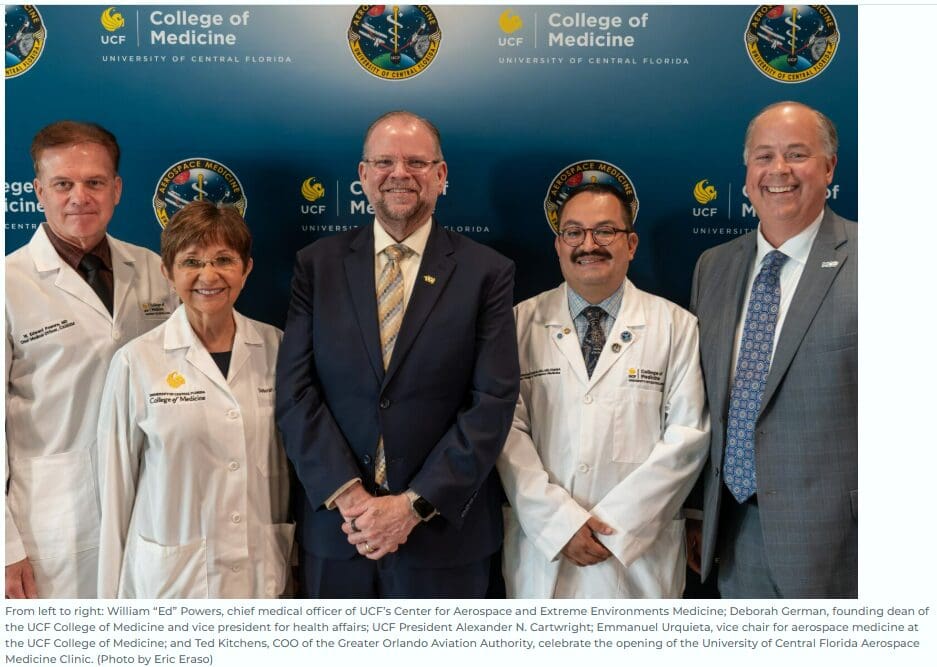
Minutes from one of the world’s most visited airports, The University of Central Florida has opened a new clinic to help pilots meet Federal Aviation Administration (FAA) medical requirements to fly safely. The new University of Central Florida Aerospace Medicine Clinic at UCF Health Faculty Physician Practice in Lake Nona is led by William “Ed” Powers, chief medical officer of UCF’s Center for Aerospace and Extreme Environments Medicine (CASEEM) and a certified aviation medical examiner. Pilots operating civilian aircraft must have various levels of FAA medical certification depending on the type of aircraft. Commercial pilots must pass the exam every six months or each year. Visit the clinic’s webpage to learn more about FAA medical exams at UCF Health Faculty Physician Practice and schedule an appointment online. FMI: https://med.ucf.edu/news/from-the-clinic-to-the-cockpit-ucf-opens-new-faa-designated-clinic-for-pilots/
7. FAA reviews cannabis fitness standards. Existing prohibitions would remain in place while the agency studies impairment and return-to-duty standards. Last month, the Transportation Research Board published details of an FAA-funded project to review cannabis use among pilots and air traffic controllers. Current policy already prohibits marijuana use by pilots and other safety-sensitive aviation employees covered by DOT testing rules. The existing rules establish what covered individuals may not do, but the FAA says it lacks validated criteria for determining when impairment has ended after cannabis use. The review will examine how long the effects may last, how that period varies among users and how test results relate to operational fitness. The agency said it wants scientifically supported standards that could guide screening, medical certification and return-to-duty decisions. Earlier this year, the federal government moved FDA-approved marijuana drugs and marijuana covered by qualifying state medical licenses from Schedule I to Schedule III. Schedule I is the federal category for substances considered to have no accepted medical use. Schedule III recognizes accepted medical use and a lower potential for abuse. Recreational marijuana remains in Schedule I while a separate federal proceeding considers moving the broader category to Schedule III. FMI: https://avweb.com/aviation-news/faa-reviews-cannabis-fitness-standards/
8. US bill would open student loans for aviation degrees. AIN online reported on 6 Aug that U.S. student loans could become more accessible for aspiring pilots, aircraft mechanics, and air traffic controllers under a bipartisan House bill that would classify aviation degrees as professional degrees under federal policy. The Workforce Innovation for Next-Gen in Skies (WINGS) Act was introduced by Rep. Joyce Beatty (D-Ohio) and co-sponsored by Representatives Elise Stefanik (R-New York) and Frederica Wilson (D-Florida). More than a dozen universities and several industry stakeholders have expressed support for the legislation. “We thank Representatives Beatty, Stefanik and Wilson for recognizing that financial constraints are among the obstacles confronting those seeking careers in aviation,” said NBAA president and CEO Ed Bolen. “This legislation will help remove those barriers, ensuring talented individuals are able to complete the education and training needed to pursue rewarding vocations in an essential American industry.” FMI: https://mail.yahoo.com/n/list/folders=1&listFilter=ALL_INBOX/messages/29928?guce_referrer=aHR0cHM6Ly9sb2dpbi55YWhvby5jb20v&guce_referrer_sig=AQAAANuv7epzYg9qtS1AKxNi5sS_ykRq34RsQxjJx7SntGw-u4M2Cs3wJIgywlNarM7pu01oXdTLhG-PJVLW2nKzAOk022AJcjOVCo9GMcbY_0BVuer9wIhKYTX3TuH-CaN-oC9cihNWKZfGBBOOUJcAxnjn7_OvBg_xJ-WHnFU8n1vj and https://beatty.house.gov/sites/evo-subsites/beatty-evo.house.gov/files/evo-media-document/beatty_025_xml.pdf?utm_campaign=AIN%20Alerts&utm_medium=email&_hsenc=p2ANqtz–iu6DV_sRlmNx8qgTDsitKatKcaoPzrXgm0f4FjtwFpB8XeklgKzHRES15POTZhB42N8xKrv9ZQgZB_dHG5gHnoEt_zA&_hsmi=431973184&utm_content=431973184&utm_source=hs_email
9. AAM update 1: Congress targets AAM certification timelines.

Avweb reports on 4 Aug that Congress moved last month to advance legislation intended to make the FAA’s certification process more predictable for advanced air mobility (AAM) aircraft. The Aviation Innovation and Global Competitiveness Act would require the agency to publish a certification plan and expected time ranges for major steps in the review process. On July 22, the Senate Commerce Committee advanced S. 3885 by voice vote. Companion legislation, H.R. 7553, has been introduced in the House. The bill would give the FAA 180 days after enactment to develop and publish a certification plan for aircraft intended for AAM operations. The plan would address the agency’s issue-paper process, recurring certification questions, performance-based standards and the circumstances under which industry consensus standards could serve as an acceptable means of compliance. FMI: https://avweb.com/aviation-news/congress-targets-aam-certification-speed/ and https://www.budd.senate.gov/wp-content/uploads/2026/07/Aviation-Innovation-and-Global-Competitiveness-Act-Final-Bill-Text-1.pdf
10. AAM update 2: Electric air taxis are finally ready for takeoff.

In a story that first ran in Fortune.com, re-printed in Yahoo on 3 August, Air taxis are closer than ever to becoming a reality thanks to a confluence of new technology, competition, and regulatory developments. Starting this summer, a series of federally sanctioned pilot projects across the U.S. will let Joby and several other companies developing a new breed of all-electric aircraft start carrying cargo, then passengers, in real-world tests. If successful, the trials could open “another axis of transportation” that can bypass physical geography such as mountains and human-created boundaries like traffic, says Sciarra. The government’s online announcement of the pilot program included a short video clip from The Jetsons, the 1960s cartoon series that instilled flying cars in the public imagination. Outside of cartoon land, however, the notion of boarding an exotic new flying machine—particularly one not yet certified by the Federal Aviation Administration—might not reassure a wary public. In the meantime, the government has selected Archer to conduct tests in Florida, Texas, and New York/New Jersey through the Trump administration’s cumbersomely named Electric Vertical Takeoff and Landing and Advanced Air Mobility Integration Pilot Program, or EIPP. The three-year program lets selected companies and states test eVTOLs before obtaining FAA certification first. (Aircraft must be going through the certification process to participate.). Joby’s stock jumped 8% on Tuesday in connection with these developments, by the way. FMI: https://fortune.com/2026/08/03/electric-air-taxis-joby-aviation-evtols-archer-aviation/ and https://www.yahoo.com/finance/technology/articles/electric-air-taxis-finally-ready-070000228.html and https://www.yahoo.com/finance/markets/stocks/articles/joby-stock-pops-8-us-170015620.html
11. AAM update 3: Archer unveils its new Halo autonomous VTOL.

Archer Aviation introduced Halo the week of 20 July, the commercial version of an autonomous VTOL aircraft platform developed jointly with Anduril. The two companies unveiled the aircraft this week at the Farnborough International Airshow, where Anduril presented the defense version under the name Thunder. Halo uses a series hybrid-electric powertrain and two tiltrotors that adjust rotor speed for different phases of flight. Archer said the aircraft will have a modular payload bay and is intended for freight, offshore support, humanitarian supply and maritime operations. The company did not announce performance specifications, pricing or a timeline for commercial service. FMI: https://avweb.com/news/archer-unveils-halo-autonomous-vtol/?utm_source=omeda&utm_medium=email&utm_campaign=Email-News0-AVW-260726-Osh&oly_enc_id=6088E0246256I1A
12. UAS update 1: Drone deliveries commence in central Florida.
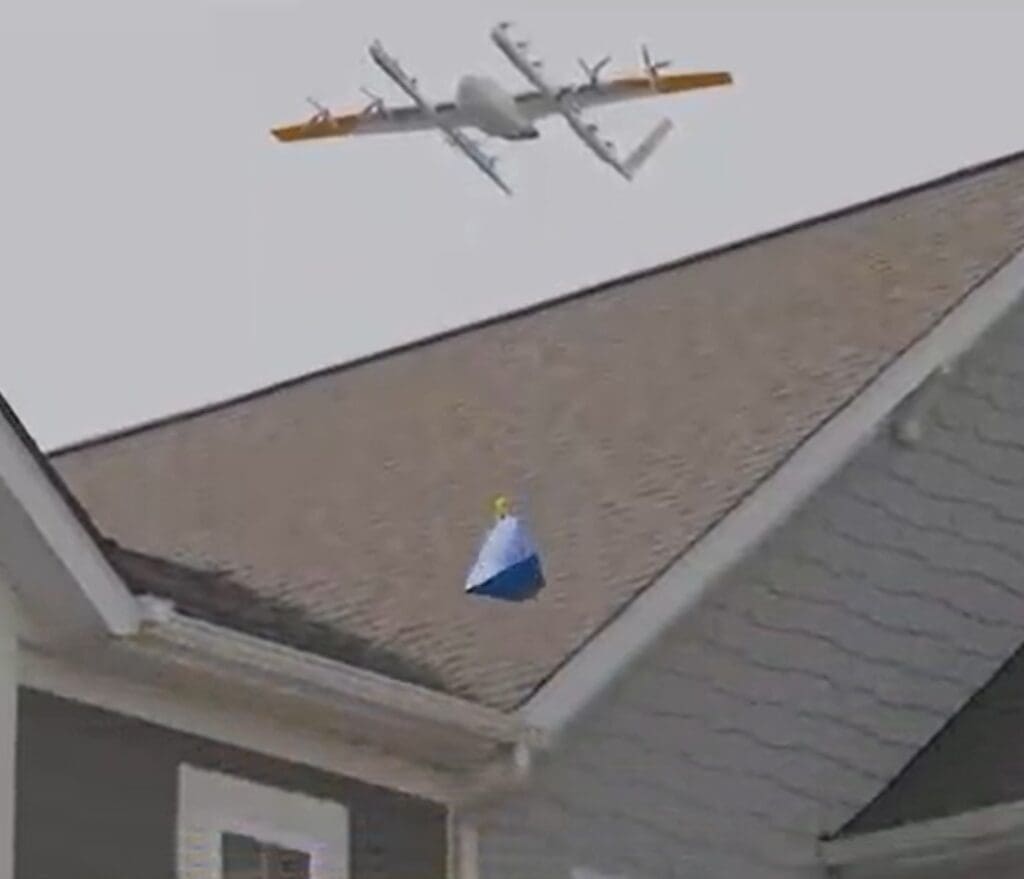
On Thursday 30 July, WFTV Channel 9 reported that some customers in central Florida can now have their groceries delivered by drone. The commencement of scaled-up service has the potential to reach 50,000 households. Walmart has entered into a partnership with WING to begin delivering purchases that are able to be transported by drone, at the customers’ option. The first two Walmarts to offer the service are the one at 1700 South OBT in Apopka and the store on Johns Lake Rd in Clermont; more are on the way.
By Friday 31 July, WFTV and multiple other outlets reported that the food delivery service DoorDash has received FAA Part 135 certification to conduct drone-based deliveries as well. Their service will be known as DoorDash Air. FMI: https://www.wftv.com/news/more-than-50000-central-florida-homes-now-eligible-walmart-drone-deliveries/8ac04db5-8d05-49ee-a680-4cdf90b35cf8/ and https://about.doordash.com/en-us/news/doordash-air and https://www.foxnews.com/tech/doordash-gets-faa-approval-delivery-drones . FAA policy on this topic can be found at https://www.faa.gov/uas/advanced_operations/package_delivery_drone .
13. UAS update 2: China targets US firms and drone exports after FCC, Xinijiang actions. Several outlets reported on 5 August that China’s Commerce Ministry has barred domestic organizations and individuals from doing business with seven U.S. entities, tightened export controls on U.S.-bound drones and related technology, and restricted U.S. agencies’ role in mandatory Chinese factory certification inspections. The report also cited Washington’s addition last week of more than 40 Chinese entities to its Uyghur Forced Labor Prevention Act entity list. The announcement also came after Reuters reported that the Trump administration was drafting a national-security measure to bar U.S. imports of new models of Chinese data-center components, including optical transceivers. “This is a retaliatory move, and it’s hardly a surprising one,” said Alfredo Montufar-Helu, Beijing-based managing director at Ankura China. “Beijing has spent the past several months building out its countermeasures toolkit.” Beijing said the moves responded to recent U.S. restrictions affecting Chinese telecom operators, testing laboratories, drones, consumer routers, submarine cables, advanced robotics equipment and power inverters.
FMI: https://www.reuters.com/world/asia-pacific/china-targets-us-firms-drone-exports-after-fcc-xinjiang-actions-2026-08-05/ and https://www.cnn.com/2026/08/05/china/china-us-sanctions-intl-hnk
14. FAA issues statement on Boeing 737 MAX-7 certification. On 3 August, the agency published a statement on its public website announcing an amended Type Certificate for the highly scrutinized line of upgraded B-737’s. The statement contains the following: “Following almost a decade of extensive review, the FAA has issued an amended type certificate and updated Production Limitation Record for the Boeing 737 MAX-7. The approval reflects years of sustained work to resolve complex technical issues and complete a thorough review of the airplane’s design and supporting safety analyses. Throughout the process, the FAA performed or directly reviewed significant work involving flight controls, system safety assessments, human factors, flightcrew alerting, and other novel, complex, or safety-critical areas, while also requiring testing, design changes, and additional analysis where necessary.” Additional details are within the press release. FMI: https://www.faa.gov/newsroom/faa-statement-certification-boeing-737-max-7
15. FAA issues statement on 5G interference issue. This is a story we followed from its beginnings. On Wednesday 22 July, the FAA issued a presser on its website that says the FAA will issue a final rule to ensure aircraft radio altimeters can withstand interference from 5G wireless signals in neighboring spectrum bands. The FAA will issue the rule on Friday July 24 in conjunction with the Report and Order that the Federal Communications Commission (FCC) adopted this morning for new 5G spectrum band auctions. The FAA’s rule will require all altimeters to meet next-generation performance requirements when aircraft equipped with them are operating in the United States. Radio altimeters are critical safety equipment that enable takeoffs and landings in low visibility and measure an aircraft’s height above terrain and obstacles, providing accurate altitude readings to pilots and aircraft safety systems. Next generation altimeters will prevent interference from 5G signals in neighboring spectrum bands that could cause inaccurate readings. The altimeter performance requirements and adoption schedule in the FAA final rule is aligned to the FCC’s Report and Order and is the result of extensive coordination between the two agencies. FMI: https://www.faa.gov/newsroom/faa-statement-5g
16. FAA issues Airworthiness Directive for DA-42 aircraft. On July 17, 2026 the FAA issued Airworthiness Directive (AD) 2026-14-08 for Diamond Aircraft Industries GmbH DA 42 airplanes. This AD was prompted by occurrences of uncommanded rudder deflection caused by a cracked nose landing gear (NLG) hydraulic actuator rod end, which could lead to failure of the NLG actuator and interference with the rudder control system, forcing the rudder into left-hand deflection. This AD requires repetitive inspections of the affected part, and, for certain airplanes, a prohibition of touch and go takeoffs and landings, pending accomplishment of the initial inspection. The AD is published in the Federal Register here. For further information about this AD, please contact Zakaria Abdi, Aviation Safety Engineer, FAA; email: zakaria.f.abdi@faa.gov. FMI: See FAA Notice NOTC5129.
17. Lycoming extends TBO to 2600 hours for several piston powerplant product lines. Lycoming Engines is extending the recommended time between overhauls (TBO) for a broad range of its piston aircraft engines, giving eligible operators hundreds of additional hours before a scheduled overhaul. This week (21 July) the company announced that the base TBO for a large majority of its factory-new and rebuilt fixed-wing engines is increasing to 2,600 hours, an increase of 400 hours from the previous 2,200-hour standard. Lycoming said the change is intended to reduce operating costs and increase aircraft availability by allowing engines to remain in service longer between overhauls. The new TBO applies to multiple engine families, including the O-320, IO-320, O-360, IO-360, IO-390, O-540 and IO-540 series. Eligibility depends on the specific engine model and its operating and maintenance history, and operators must continue to comply with applicable Lycoming technical publications and FAA airworthiness requirements. FMI: https://avweb.com/aviation-news/lycoming-extends-tbo-2600-hours/
18. Piper adding service center, helping Robinson with R-88, partners with Aura Aero.
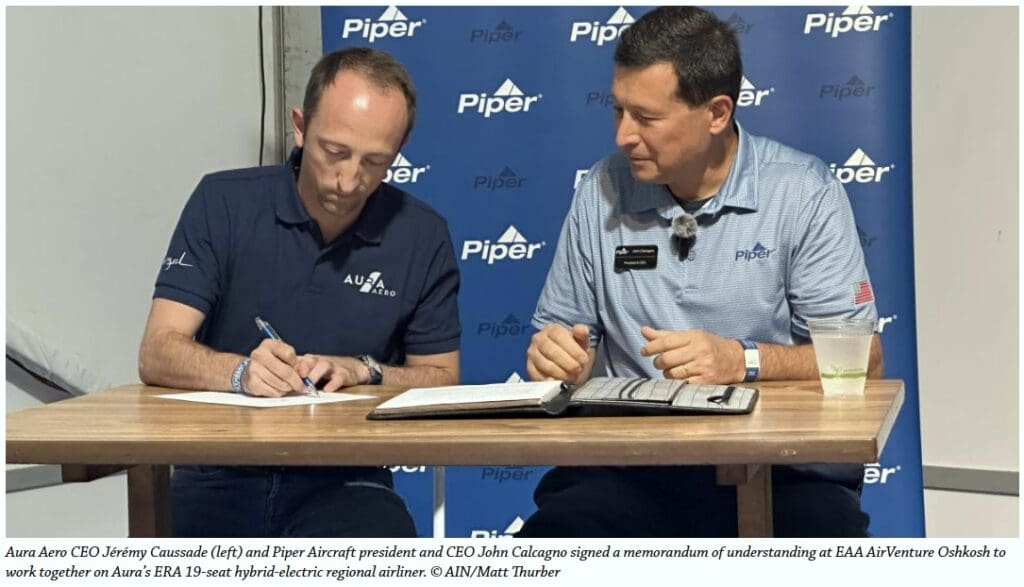
In a story of great local interest, AIN Online reports that as Piper Aircraft celebrates its 90th anniversary, president and CEO John Calcagno announced at EAA AirVenture Oshkosh the expansion of the company’s Vero Beach headquarters with a new service center. Meanwhile, Piper Industrial Manufacturing Co. (PIMCO) will help Robinson Helicopter with sheetmetal manufacturing for the in-development R88 helicopter, as well as partner with Aura Aero on its ERA 19-seat hybrid-electric regional airliner. “This collaboration leverages Piper’s more than 90 years of aerostructures design and certification expertise to advance sustainable aviation,” said Calcagno. “Both Piper Aircraft and PIMCO are aligning ourselves with a leader in the advancing air mobility sector.” The new 33,000-sq-ft service center will add dedicated maintenance space but will also be used for new and preowned airplane deliveries and will have customer and administrative offices. Along with seven indoor airplane bays, an 11,000-sq-ft outdoor service area will have four bays. Piper Aircraft plans to break ground on the new facility later this year, and it will open for business in the fourth quarter of 2027. FMI: https://www.ainonline.com/aviation-news/air-transport/2026-07-29/piper-helping-robinson-r88-manufacturing-process?utm_campaign=AIN%20Alerts&utm_medium=email&_hsenc=p2ANqtz-_Jyhgv10SkOoMtsf91cFgJ9weEBPeWTNngzkksKr8wxvG08F2GH4IEy9P0lx7I9sd5txx0g9wXWFqEdRrqXrjoZnNOAA&_hsmi=431789355&utm_content=431789355&utm_source=hs_email
19. Charter operator offers priority hurricane evacuation flights.
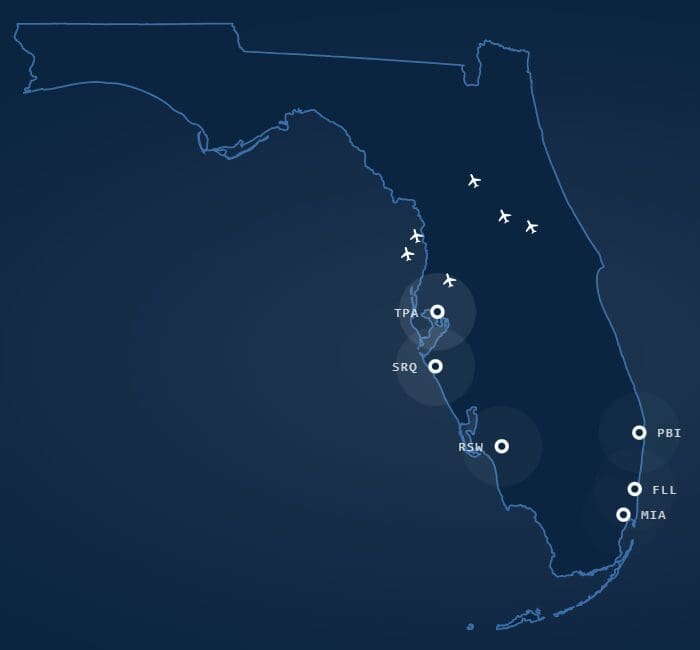
new Part 121 charter aircraft service operating under the GlobalX umbrella, called Priority Evac is offering no-waiting hurricane evacuation air charter service from several Florida airports, none of which are in the Orlando jurisdiction. The service is not cheap! Expect to pay in the $20K-plus range if booking. The website indicates that the aircraft used are A-320’s. Editor’s note: this is not an endorsement, but a public safety service to raise awareness ahead of an emergency like a hurricane. FMI: See their website at https://www.priorityevac.com/.
20. FAA Safety Briefing magazine, Summer edition now in publication.
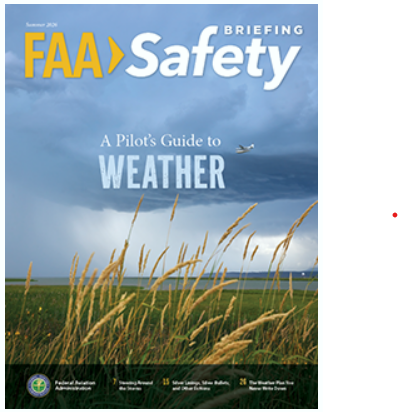
As we reported previously, this popular print journal has now gone to quarterly publication. The Summer 2026 issue of FAA Safety Briefing magazine focuses on aviation weather and its critical effect on safe GA flying. Articles review some basic causes of weather activity, how certain conditions can affect pilot safety, and tools you can use to aid your weather decision-making process. FMI: https://www.faa.gov/newsroom/safety-briefing/faa-safety-briefing-magazine
21. GAJSC Safety Promotion Outreach Topics of the Month (NPP63; formerly NPP14) for FY-2026.
The list of Topics of the Month (TOM’s; NPP63) and Airworthiness Topics of the Quarter (TOQ’s; NPP60) from the General Aviation Joint Safety Committee (GAJSC) for FY-2026 moves into the fourth quarter. Reps can download this media off the FAASTeam National Collaborative Center (NFRCC) Sharepoint site at FAASafety.gov. Volunteers who mail me a USB flash drive with at least 1 GB of capacity can obtain the full catalog of media, including NPP60 and NPP63, for the current year. Previous years are available, depending on memory capacity. Here are the topics of the month (TOM’s) for FY-26; I can provide a slightly more detailed description with your download (and available on request!). The GAJSC has a free subscription service to its e-newsletter; check out The TOM / TOQ media for FY-2026 are posted in the FAASTeam Sharepoint site; editor will make these available to other Reps with prior coordination.
Oct 2025: Human Performance.
Nov 2025: CFIT.
Dec 2025: Winter Ops.
Jan 2026: Risk Management.
Feb 2026: Multi-Engine Transition.
Mar 2026: Human Factors and WINGS.
Apr: 2026: Angle of Attack Awareness.
May 2026: Owner-Operator and Mechanic Relations.
Jun 2026: Hindsight Bias.
Jul 2026: Tailwheel Endorsement.
Aug 2026: Pre-and In-Flight Wx Resources
Sep 2026: Advanced Air Mobility.
22. GAJSC GA Maint. Safety Outreach Topics of the Quarter (NPP60; formerly NPP41) for FY-2026. Along with the Topics of the Month shown above, national FAASTeam also publishes a series of Airworthiness Topics of the Quarter. For FY-26, the selected topics are as follows:
- First Quarter (Oct – Dec): Wiring.
- Second Quarter (Jan – Mar): Airworthiness.
- Third Quarter (Apr – Jun): Field Approvals.
- Fourth Quarter (Jul – Sep): Helicopter Mx Accidents.
The same structure surrounds these topics as for Topics of the Month. In other words, resources are available; just add speaker and venue! Note: all FY-23 thru FY-25 topics available. Contact the Orlando FSDO FPMs for more info!
23. Airmen Certification Standards (ACS) and Practical Test Standards (PTS) updates. Make sure you go to your next Practical Test armed with the latest ACS or PTS as appropriate!!! The FAA is gradually replacing all PTS with the new and improved ACS; only a few PTS have not yet been converted. All current ACS’s can be found at this website: http://www.faa.gov/training_testing/testing/acs/ . An ACS Companion Guide for Pilots is available to help explain ACS and integrate ACS into one’s training plans: https://www.faa.gov/training_testing/testing/acs/acs_companion_guide_pilots.pdf .
Two new ACSs to report this month:
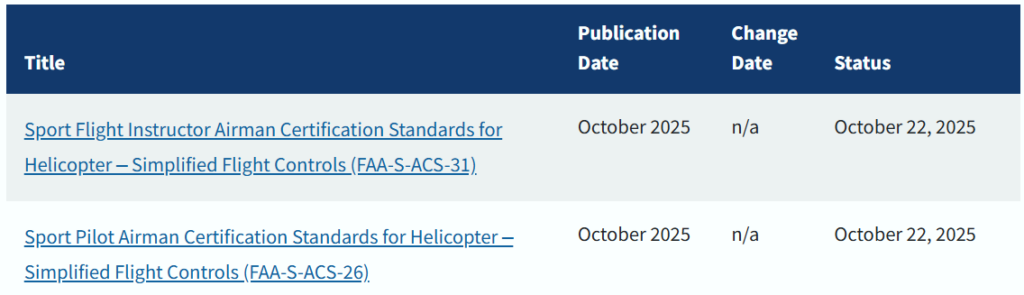
No new PTSs to report this month.
Airmen Testing Community Advisory website: https://www.faa.gov/training_testing/testing The national ACS Focus Team encourages and invites all users of the ACS to please let them know if you see any possible problems or issues with the ACS, or questions not covered already in the Airman Certification Standards FAQ link on the webpage above. You do not have to go through anyone or any organization to reach the ACS Focus Team – just send an email to: 9-AVS-ACS-Focus-Team@FAA.gov The ACS Focus Team welcomes your feedback.
PTS. PTS’s are still very much around! The link to Practical Test Standards (PTS) is at the end of this report in the FAA resources section. Although many PTS are still in use, they are not being substantially updated, and ACS will eventually replace all PTS pubs.
24. And now, Regulatory trivia.

Question: Where are the VOR Receiver Check Points for Florida? What about VOT’s? Where can I find them in publication?
Answer:
The currently published VOR Receiver Check points in Florida are as follows:
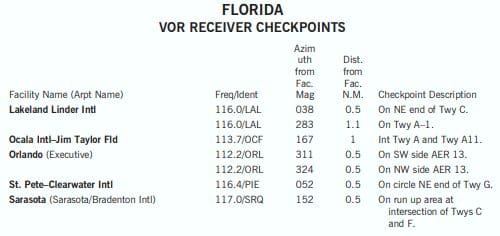
This is published in the Chart Supplement Southeast US, Section 4. There are no longer any VOR Test Facilities (VOT’s) in Florida (dang!), and only a handful of them in the entire SE region. Requirements for the VOR receiver check are in FAR 91.171, and procedures are in the Aeronautical Information Manual (AIM), Paragraph 1-1-4. CFI’s: Please show your students on a dual XC how to use a VOR Receiver Checkpoint, including the necessary documentation. FMI: Check out 14 CFR 91.171(a) and AIM, Paragraph 1-1-4, both of which can be found in drs.faa.gov, the Dynamic Regulatory System. Chart Supplement Southeast: https://aeronav.faa.gov/Upload_313-d/supplements/CS_SE_20260319.pdf
25. Runway Safety Action Team (RSAT) Calendar (NPP05). Here’s our latest info on upcoming RSAT’s within the Orlando District. Thanks to Javier Calderin at the FSDO!
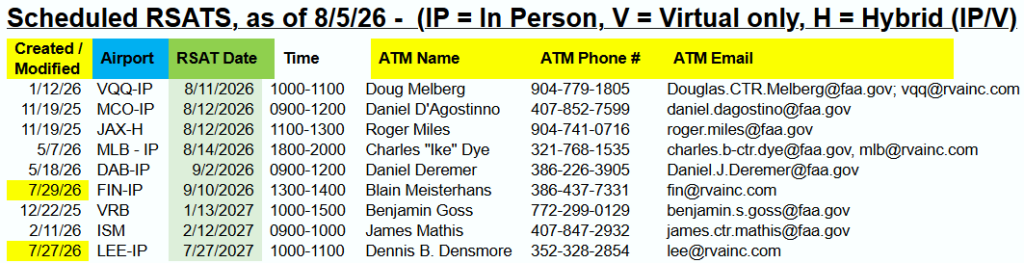
Note: DAB Double-header: Daytona Beach (DAB) is also hosting a Pilot-Controller Forum on Tuesday 1 Sep at 1700 ICW the above-listed RSAT; Please see SPANS Select ID number SO15142662.
The public is invited to attend any of these meetings and can earn WINGS Knowledge credit for doing so. FAASTeam Lead Reps: Please coordinate with ATC at the respective airports and help get the word out via SPANS message, and incentivize attendance with WINGS Knowledge credit. RSAT meetings combined with a Pilot – Controller Forum are an excellent draw.
Please note the airports within your area. Please work well ahead of the schedule: Submit the associated SPANS message 3 weeks prior to any RSAT meeting in your area of responsibility. Set up any virtual event as a webinar in SPANS and obtain the meeting link from ATC. Contact the ATM for the respective airport or contact the FPM at the Orlando FSDO for more info relating to the RSAT’s at the airports in your area.
Bipartisan Senate bill targets airport surface safety. Speaking of runway safety, U.S. Senators are pushing new bipartisan legislation aimed at reducing runway incursions by improving airport vehicle training and expanding the use of surface safety technology. The Runway Surface Awareness and Focused, Effective Training and Technology (Runway SAFE-T) Act, introduced Tuesday by Sens. Jerry Moran (R-Kan.) and John Hickenlooper (D-Colo.), follows a series of high-profile runway incidents, including the March accident at New York’s LaGuardia Airport in which a landing airliner collided with an airport fire truck. The proposal would establish an FAA-led task force charged with reviewing airport driver training programs and recommending best practices for vehicle operations in movement areas. The panel would include representatives from airports, the FAA, the NTSB, emergency response organizations, airport vehicle operators and other aviation stakeholders. Its recommendations would be delivered to the FAA within one year. FMI: https://avweb.com/aviation-news/runway-safe-t-act-airport-surface-safety/ and https://www.moran.senate.gov/public/index.cfm/news-releases?ID=92EBFD2B-1C4B-494C-A1DC-3D51B3C34BA1
27. Florida Airshows and Aviation Events calendar. Here is the latest compilation of known shows and events coming up within Florida (besides events you can find in faasafety.gov). Cancellations will be shown in strike-through font. As always, be vigilant for associated TFR’s with any airshow, rocket launch, racing event, wildfires or VIP visits (see Review of Current TFR’s below). Please check the official show websites for more info. Boldface means the event is within the Orlando FSDO. ICAS source: https://www.airshows.aero/Page/ASCalendar ;
Also, AIN Online is a worldwide source. Another overall source for Florida: https://floridareview.co.uk/florida-events/florida-air-shows
2026:
Plane Time 34 (Florida Aviation Network live-stream): 15 Aug
Plane Time 35 (Florida Aviation Network live-stream): 17 Oct
Air Dot Show Orlando (KSFB): 17 – 18 Oct
NAS Jacksonville Air Show (KNIP): 17 – 18 Oct
Blue Angels Homecoming Air Show (KNPA): 6 – 7 Nov
Florida Int’l Air Show (KPGD): 7 – 8 Nov
Stuart Air Show (KSUA): 13 – 15 Nov
Forgotten Coast Freedom Festival Air Show (AAF): 20 – 21 Nov
Vintage Weekend Ocean Reef Air Show (Key Largo), 4 – 5 Dec
Plane Time 36 (Florida Aviation Network live-stream): 19 Dec
28. Current GA aeronautical charts & pubs for central Florida. Make sure your chart database is current. Here are the current and future Dates of Latest Editions (DOLE’s) for the 56-day aeronautical pubs. Most pubs are on a 56-day cycle, and digital pubs follow suit:
2026: 9 Jul, 3 Sep, 29 Oct, 24 Dec.
These dates cover the following pubs and their digital equivalents on your EFB:
IFR Low Alt En-route Charts (e.g., L-23);
IAP’s – US Terminal Procedures Publication (e.g., SE-3);
Chart Supplement (formerly the A/FD) [Man, I sure miss those back-cover indices!]
Jacksonville and Miami VFR Sectionals;
Tampa / Orlando and Miami Terminal Area Charts.
FMI: Check out the following website for current chart editions: https://www.faa.gov/air_traffic/flight_info/aeronav/productcatalog/doles/
Also: Check out the following official website as a navigation training resource: https://www.faa.gov/air_traffic/flight_info/aeronav/digital_products/aero_guide/
for a link to all chart symbology used for all FAA aeronautical charts and pubs.
29. Review of current Florida TFR’s. The ones shown in the screen shots below were valid just within Florida at the time of final editing, but can and do change or expire, and this newsletter is not to be construed as an official source. Note the long-term TFR over Mar-A-Lago. Always check NOTAM’s each time before you fly! FAA’s official TFR NOTAM website is http://tfr.faa.gov/tfr2/list.jsp . Also, check out their interactive TFR map page at https://tfr.faa.gov/tfr3/?page=map . Other resources are available as well, including via www.1800wxbrief.com , www.AOPA.org/go-fly/tfrs and on many flight planning apps. In flight, contact with ATC including VFR flight following, or contacting Flight Service could be helpful. For planning info regarding other Special Use Airspace, visit www.SUA.FAA.gov.
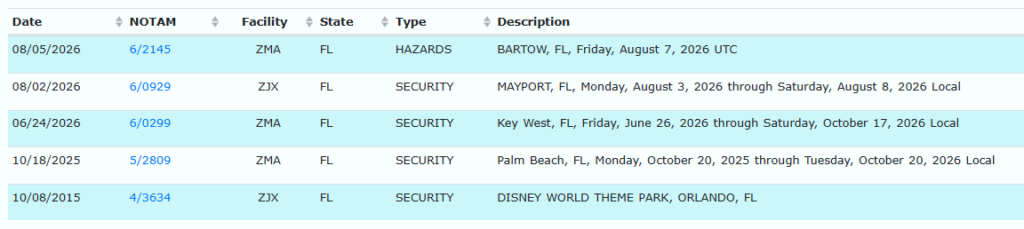
- Nationwide: Going to the Bahamas or across the ADIZ? Check this one out: “USA” NOTAM FDC 2/8783, covers operations across the ADIZ.
- UAS Operators: Check out the following:
- FDC 6/3366, addressing UAS restrictions near “National Defense Airspace”. This NOTAM replaces FDC 5/2595.
- FDC 5/3402, addressing UAS ops near US Navy, CBP, or USCG vessels
- FDC 5/6379, covering UAS ops near naval submarine bases (Kitsap, WA and Kings Bay, GA). This NOTAM replaces FDC 3/9568.
- FDC 5/6874, addressing UAS ops in the vicinity of Cape Canaveral and Kennedy Space Center.
- Don’t forget to always check other FDC NOTAM’s for “USA” on the above web page, in addition to FL or wherever else you may be going. Set the “Center” filter to “USA”, then hit “Go” next to that box, and you’ll see the desired search results. Most of these NOTAM’s are effective nation-wide.
- Finally, if filing IFR, remember to check FDC NOTAM’s for the instrument approaches at your destination. Like TFR’s, these NOTAM’s are regulatory, too, so you have to adhere to their applicable portions. The easiest way to obtain this info is via commercial flight planning software / approved sites when filing and obtaining a standard wx brief.
30. GA awards update (NPP02).
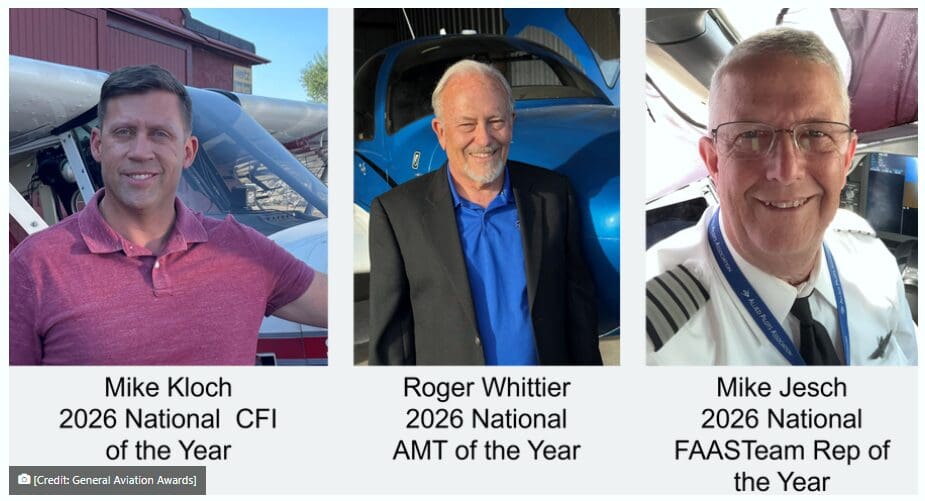
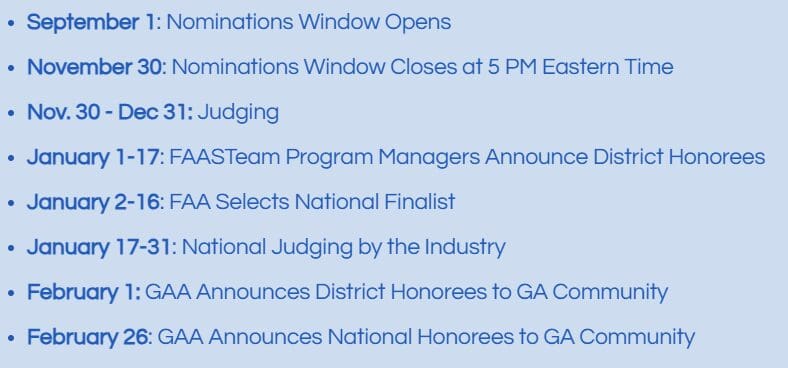
Congratulations to the 2026 GA Award winners: Mike Kloch, CFI of the Year; Roger Whittier, Aviation Technician of the Year, and Mike Jesch, FAASTeam Rep of the Year, who received their awards at official ceremonies at AirVenture. The cycle now rolls over for 2027. The Orlando district has produced many national honorees, including Obie Young, Walt Schamel, Vicki Sherman, the late Rock Rockcastle, and three national winners between 2017 and 2023: Mark Ducorsky (2017 Rep of the Year), the late Ron Timmermans (2021 CFI of the Year, NAFI Flight Instructors’ Hall of Fame 2022) and Bob Raskey (2023 CFI of the Year). FMI: https://avweb.com/news/general-aviation-awards-recognizes-2026-national-honorees/ and www.generalaviationawards.com The most recent GA Award calendar from the website is shown below, and it generally remains perennially stable (government shutdowns notwithstanding!):
31. Contacting Bob Jex. Bob Jex, editor of this newsletter, can be e-mailed at bob.jex@yahoo.com. Please update your contact info and use this address as the primary. The earthlink.net email is secondary; for the time being, both addresses work.
As always, fly safe!
Archived Links to select official pubs and sites of interest:
Each story above contains a reference link when available. Looking for a particular web resource not listed? Ask me and I’ll look for it. Once I find it, I’ll list it here! E-mail requests to bob.jex@yahoo.com . New listings in yellow for first month or so.
Federal Aviation Administration (FAA); see elsewhere within this newsletter
- Orlando FSDO website: https://www.faa.gov/about/office_org/field_offices/fsdo/orl
- FAASTeam Website (center of FAASTeam universe): www.faasafety.gov
- Dynamic Regulatory System (DRS): drs.faa.gov/browse (Relocated link)
- Airmen Inquiry portal: https://amsrvs.registry.faa.gov/airmeninquiry/
- FAA introduction for international audiences: https://avssp.faa.gov/avs/afsfaast/asw/Hughes%20Inbox/Videos/We%20Are%20Aviation%20Safety.mp4
- News, press releases, fact sheets, FAA Safety Briefing, social media: https://www.faa.gov/news/
- Another source of FAA information including videos: www.medium.com/faa
- FAA publication sign-up, for free subscriptions on a wide variety of information: https://public.govdelivery.com/accounts/USAFAA/subscriber/new?preferences=true#tab1
- FAA Newsroom: A very broad source of FAA news, fact sheets, speeches, testimony, social media: https://www.faa.gov/newsroom
- Airport funding (Bipartisan Infrastructure Law): https://www.faa.gov/bil/airport-infrastructure ; search by relevant filters, including state or even airport ID.
- FAA information on relevant COVID-19 issues: https://www.faa.gov/coronavirus/
- Unleaded AvGas link: https://www.faa.gov/about/initiatives/avgas
- Media / NGO coverage on unleaded AvGas over the years: https://www.faa.gov/about/initiatives/avgas/media
- FAA 5G on-line resource: https://www.faa.gov/5g
- Pilot Training resource link: https://www.faa.gov/pilots/training/
- Airman Testing: https://www.faa.gov/training_testing/testing/
- FAA’s new NOTAM Management Service (NMS): https://nms.aim.faa.gov/
- Listing of all InFOs: https://www.faa.gov/other_visit/aviation_industry/airline_operators/airline_safety/info/all_infos
- Chart Supplement (formerly called the Airport / Facility Directory or AFD): https://www.faa.gov/air_traffic/flight_info/aeronav/digital_products/dafd/
- Special Use Airspace short-term schedule: https://sua.faa.gov/sua/siteFrame.app
Zoom in on areas of interest; click for pop-up schedule
- Aviation Training Handbooks (Free to download!): https://www.faa.gov/regulations_policies/handbooks_manuals/aviation/
- FAA website for Draft Orders, Notices, and Handbooks Open for Comment: https://www.faa.gov/aircraft/draft_docs/afs_orders/
- FAA website for NPRM’s, Final Rules: https://www.faa.gov/regulations_policies/rulemaking/recently_published/
- CFI “no-expiration”-certificate NPRM updates: https://bit.ly/3wla3sP
- Legal Interpretations search site (to help clarify regulatory issues): https://www.faa.gov/about/office_org/headquarters_offices/agc/practice_areas/regulations/Interpretations/
- FAA Safety Briefing magazine: www.faa.gov/news/safety_briefing
- Fly Safe fact sheets (Genesis for many GAJSC TOM’s): https://www.faa.gov/newsroom/safety-briefing/faa-safety-briefing-fact-sheets
- PTS link: www.faa.gov/training_testing/testing/test_standards/
- ACS link: http://www.faa.gov/training_testing/testing/acs/
- UAS (drones) link: www.faa.gov/uas
- UAS Registration: https://faadronezone.faa.gov
- Drone Dispatch (UAS News): Drone Dispatch (faa.gov)
- ADS-B Service Availability Prediction Tool (SAPT): https://sapt.faa.gov/default.php
- Also contains ADAPT, RAIM Prediction, and RAIM Summary info.
- Runway Incursion prevention series: www.faa.gov/go/FromTheFlightDeck.
- Runway Safety Pilot Simulator: www.runwaysafetysimulator.com
- Weather cameras (WCAM) program: www.weathercams.faa.gov
- Birdstrike website: https://wildlife.faa.gov/home
- Noise complaints: https://noise.faa.gov/noise/pages/noise.html Just remember, the FAA does not regulate noise in most GA aircraft!
- FAA forms index: https://www.faa.gov/forms/index.cfm/go/document.list/
- Laser strike public reporting: https://www.faa.gov/aircraft/safety/report/laserinfo
- Accident Lessons Learned database: https://lessonslearned.faa.gov
- Flight Standards Position Reports (NOTAL): FS Position Reports (faa.gov)
- Safety Alerts and Charting Notices page: Safety Alerts and Charting Notices (faa.gov)
- Space flight operations: FAA’s Operational Information System (OIS): https://www.fly.faa.gov/ois/?legacy=true . Go to “Ops Plans” on the menu and select “Current Operations”.
- ICAO Flight Plan Brochure: https://www.faa.gov/about/office_org/headquarters_offices/ato/service_units/air_traffic_services/flight_plan_filing/media/fpl_brochure_(change3).pdf
- (For the AOPA equivalent product, go to http://download.aopa.org/advocacy/0403_icao_tip_card.pdf)
- Instrument Flight Procedures (IFP) support (IAP’s, etc.): https://www.faa.gov/air_traffic/flight_info/aeronav/procedures/application/
- UAS Remote ID briefing: https://www.faa.gov/uas/getting_started/remote_id
- UAS Data Delivery Site, or UDDS: https://udds-faa.opendata.arcgis.com/
- UAS Airspace card:

- Jobs link: https://www.faa.gov/jobs/ and www.usajobs.gov
- AME Guide (Medication deferral guidance for AME’s): https://www.faa.gov/about/office_org/headquarters_offices/avs/offices/aam/ame/guide/pharm/dni_dnf/ or https://www.faa.gov/ame_guide/media/ame_guide.pdf
- Chart Supplement; Comments or Corrections: E-mail: https://www.faa.gov/air_traffic/flight_info/aeronav/aero_data/
Snail-Mail:
FAA, Aeronautical Information Services
1305 East West Highway
SSMC-4, Suite 4400
Silver Spring, MD 20910-3281 Ph: (800) 638-8972
They have an approx. 2-mo-prior publication cut-off date.
Federal Register (Exit pipe for all federal regulations)
https://www.federalregister.gov
Another broad-based, multi-agency regulatory updates website: www.regulations.gov
MOSAIC Rule (not all-encompassing; many sources are available):
- FAA site: https://www.faa.gov/newsroom/faa-proposes-rule-enhance-safety-and-performance-light-sport-aircraft
- AOPA site: https://www.aopa.org/news-and-media/all-news/2023/july/25/mosaic-proposed-rule-published
- Full NPRM as published in the Federal Register: https://www.federalregister.gov/documents/2023/07/24/2023-14425/modernization-of-special-airworthiness-certification
- NAFI archived MOSAIC webinar with EAA’s Sean Elliott on 19 Mar 2025: https://www.mentorlive.site/program/90.html
- Advisory Circular AC 61-146: https://www.faa.gov/documentLibrary/media/Advisory_Circular/AC_61-146.pdf .
- Industry watchdog comprehensive site: https://www.global-aero.com/flying-under-mosaic-a-comprehensive-guide-to-new-privileges-and-aviation-insurance-underwriting-standards/
“New” CFI Rule (Effective 1 Dec 2024):
Also, AOPA offers a FAQ adjunct to assist the transition to the new CFI rule: https://www.aopa.org/training-and-safety/cfis/flight-instructor-resources/faa-ruling-on-removal-of-the-expiration-date-on-cfi-certificates
Aviation Funding Stability Act (HR 5451)
https://www.congress.gov/bill/119th-congress/house-bill/5451
Aeronautical Information Manual (AIM)
https://www.faa.gov/air_traffic/publications/atpubs/aim_html/index.html
GAJSC – General Aviation Joint Safety Committee
NASA Aviation Safety Reporting System (ASRS)
- Report form for online submission: https://asrs.arc.nasa.gov/report/electronic.html
- “Callback” newsletter: https://asrs.arc.nasa.gov/publications/callback.html
Space Operations
General public interest websites:
Worldwide launch schedule: https://spaceflightnow.com/launch-schedule/
Space Station (ISS) flyover schedule: https://spotthestation.nasa.gov/
General Aviation Awards Info, Nomination Procedures, List of National Winners, etc.
www.generalaviationawards.com (or .org)
State of Florida (FDOT and State Gov’t)
- FDOT Bureau of Aviation: https://www.fdot.gov/aviation
- Florida Airports Directory and Florida Aeronautical Chart: https://www.fdot.gov/aviation/directory.shtm
- Airshows within Florida: https://floridareview.co.uk/florida-events/florida-air-shows
- “Online Sunshine” website (Florida Legislature) https://www.leg.state.fl.us/Welcome/index.cfm?CFID=41952797&CFTOKEN=151bfd72ea46c3b2-D8A49CF9-A9DA-6B84-49F4D22C1FD49EB6
Sun-n-Fun select web links:
- Campus layout: e8babe79-6399-455f-9b62-b34cc48f3a68.pdf (constantcontact.com)
- 2026 NOTAM: https://flysnf.org/aerospace-expo/the-notam-is-here/
Aviation Community Service
- Florida Aviation Network (FAN; project of the National Aviation Safety Foundation, NASF): www.floridaaviationnetwork.com
- National Aviation Safety Foundation (NASF): www.nationalaviationsafetyfoundation.org
- Angel Flight Southeast (Non-emergency medical transport): www.angelflightse.org
- Pilots N Paws (Pet rescue): www.pilotsnpaws.org
WINGS Industry Network: https://www.wingsindustry.com/
- EZ WINGS; WINGS credit assistance app: https://www.ezwings.net/
- WINGS Industry Network “Insights” archives: www.wingsindustry.net
WINGS Sweepstakes info and entry forms: https://www.mywingsinitiative.org/
Aircraft Owners and Pilots Association (AOPA)
- Air Safety Institute (ASI) In-Person Seminars: Either https://www.aopa.org/forms/event-calendar/SAFETY_SEMINAR or www.airsafetyinstitute.org/seminars
- Rusty Pilot Seminars (RPS) and other AOPA events: https://hangar.aopa.org/events/category/52
Seaplane Operations
- Seaplane Pilots Association: www.seaplanepilotsassociation.org
Helicopter Safety
- US Helicopter Safety Team (USHST): https://ushst.org/ This is an excellent repository of a series of safety video series called 56 Seconds to Live, which is of value to all pilot communities.
National Association of Flight Instructors (NAFI): https://www.nafinet.org
Society of Aviation and Flight Educators (SAFE): http://ww2.safepilots.org
National Flight Training Alliance (NFTA): https://www.nftaus.org/
Flight School Association of North America (FSANA): https://fsana.com/
Aeronautical Knowledge Training (ORL FAASTeam Library)
- Orlando Executive Airport FAASTeam Library: http://www.fsr-inc.org/FAAST/Seminar/Notice.aspx
Open source Aviation Accident Reports:
- FAA Aviation Safety Information Analysis and Sharing (ASIAS)
https://www.asias.faa.gov/apex/f?p=100:1:::::: ; In the “What’s New” section on the left side, FAA-derived preliminary (last 10 days in which a reportable event was received) accident and incident reports are available by clicking on “Accident and Incident Preliminary Reports”. A grid is presented with info sorted by aircraft manufacturer.
- NTSB:
- Aviation Accident Database and Synopses: https://www.ntsb.gov/_layouts/ntsb.aviation/index.aspx
- GA Accident Visualization Tool, including tutorials on how to use this resource: www.ntsb.gov/safety/data/Pages/GeneralAviationDashboard.aspx.
- GA Safety section, including run-down on fatal GA Accidents in past week:
https://www.ntsb.gov/investigations/AccidentReports/Pages/GA.aspx
- See also AIN Online,com for recent accident / incident summary involving business aviation, charters, airlines
- Kathryn’s Report: http://www.kathrynsreport.com/
UAS Reporting (non-FAA)
- Unmanned Safety Institute: www.unmannedsafetyinstitute.org (unconfirmed link)
- Association for Unmanned Vehicle Systems International (AUVSI): www.auvsi.org
- UAS Industry news and product reviews: https://dronedj.com/
- Part 108 Draft NPRM (BVLOS Operations): https://www.federalregister.gov/documents/2025/08/07/2025-14992/normalizing-unmanned-aircraft-systems-beyond-visual-line-of-sight-operations
Islands of the Bahamas / Bahamas Ministry of Tourism
- Official site: https://www.bahamas.com/
- For FAA Caribbean VFR Sectional charts, check out https://www.faa.gov/air_traffic/flight_info/aeronav/productcatalog/vfrcharts/caribbean/
- AOPA: https://www.aopa.org/travel/international-travel/bahamas
What else do you want to see listed here??? Let me know and I’ll look it up!
Prepared by:
Robert Jex, Ops FPM Emeritus
(M) (772) 713-1169 (text, no voice mail)
Bob.jex@yahoo.com
Reg Updates/F/Obie P/FAN Web/Monthly Reg Updates – Jex/260808